On this page
Quick answerSix columns, and the amount is quantity times rateAn illustrative villa bill, in made-up currency unitsSections roll up into one collectionWhere a villa bill usually puts each tradeUnits, and the method of measurement named in the billRed flags when two contractor bills do not matchQuick answer
A bill of quantities (BOQ) is a priced list of villa work: each line has an item description, a unit, a quantity, a rate and an amount, and the amount is the quantity multiplied by the rate. Before comparing two contractor bills, read the item description, the unit, the quantity, the rate and the amount, then the preliminaries, the provisional sums and the prime cost sums. In the illustrative bill, 100 × 50 = 5,000 and the seven made-up lines add to 35,000 currency units. Those units are not a Qatar, UAE or Saudi price.
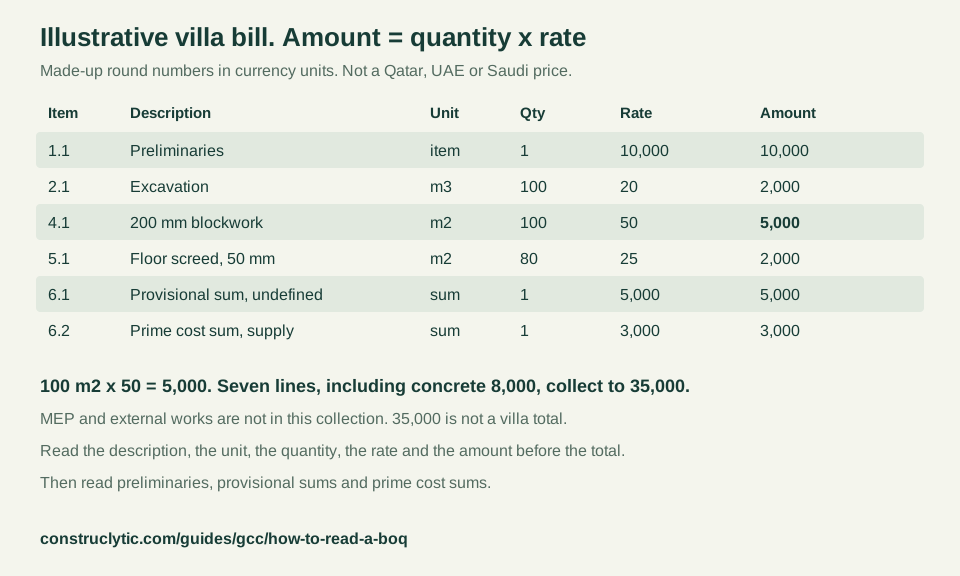
Six columns, and the amount is quantity times rate
How to read a BOQ starts on one line, not on the last page. The usual columns are item number, description, unit, quantity, rate and amount. The item number is the address of the line, so a later variation can point at 4.1 rather than at “the blockwork somewhere in the bill”. The description says what the line is. The unit says how that thing was counted. The quantity is the count. The rate is the price for one of that unit. The amount is the line total. Amount = quantity × rate. A bill of quantities for a villa is that line, repeated, then collected into sections.
The six headings are a reading layout. They are not a clause this page copies out of a standard. Principles of Measurement (International), general principle GP2.4 in the June 1979 text, says the section headings do not fix how the bill is presented. If the bill in front of you uses different column names, translate them back to these six jobs before you compare it with another bill. A rate written in the amount column, or a quantity written against the wrong unit, will not survive that check.
An illustrative villa bill, in made-up currency units
The table is an illustrative example. Every quantity and every rate was chosen as a round number so the multiplication is obvious. The currency is written CU, for currency unit. It is not a Qatari riyal, a UAE dirham, a Saudi riyal or a US dollar, and it is not a quotation. Do not take 50 CU per square metre of blockwork, or 400 CU per cubic metre of concrete, onto a real plot. Replace both the quantity and the rate with the drawing and the written offer.
Read the arithmetic across the row, then down the amount column. Preliminaries: 1 × 10,000 = 10,000. Excavation: 100 × 20 = 2,000. Footing concrete: 20 × 400 = 8,000. Blockwork: 100 × 50 = 5,000. Floor screed: 80 × 25 = 2,000. The provisional sum is already a sum, so 1 × 5,000 = 5,000. The prime cost sum is the same kind of line, 1 × 3,000 = 3,000. Adding the seven amounts gives 10,000 + 2,000 + 8,000 + 5,000 + 2,000 + 5,000 + 3,000 = 35,000 CU. If a contractor’s amount does not equal the quantity times the rate, the line is wrong before any argument about price begins.
| Item | Description | Unit | Qty | Rate (CU) | Amount (CU) |
|---|---|---|---|---|---|
| 1.1 | Preliminaries, site setup | item | 1 | 10,000 | 10,000 |
| 2.1 | Excavation, not exceeding 1.00 m | m³ | 100 | 20 | 2,000 |
| 3.1 | Reinforced concrete in footings | m³ | 20 | 400 | 8,000 |
| 4.1 | 200 mm hollow block wall | m² | 100 | 50 | 5,000 |
| 5.1 | Sand-cement floor screed, 50 mm | m² | 80 | 25 | 2,000 |
| 6.1 | Provisional sum, kitchen fittings, undefined | sum | 1 | 5,000 | 5,000 |
| 6.2 | Prime cost sum, sanitary fittings, supply | sum | 1 | 3,000 | 3,000 |
Sections roll up into one collection
A villa bill is usually printed in sections, and each section has its own collection. The summary is those collections added together. It is not a new measurement. In the illustrative bill the section amounts are the line amounts: preliminaries 10,000, substructure 2,000, concrete 8,000, masonry 5,000, finishes 2,000, provisional sums 5,000 and prime cost sums 3,000. The collection is 35,000 CU, the same 35,000 as the seven lines. If the summary shows a different total, one of the collections was typed again instead of being carried forward.
The illustrative bill stops there on purpose. It has no mechanical and electrical section and no external works. A total of 35,000 CU is the total of these seven lines, not the total of a villa. A second bill that adds air conditioning, a boundary wall or a driveway is pricing a larger job. Subtracting the two totals does not tell you who is cheaper. The per-square-metre benchmarks on this site are a different document again: they are not a line you can drop into this collection. Where a source was opened, they stay on GCC construction cost per m² 2026.
| Section | Lines carried forward | Amount (CU) |
|---|---|---|
| 1 Preliminaries | 1.1 | 10,000 |
| 2 Substructure / excavation | 2.1 | 2,000 |
| 3 Concrete | 3.1 | 8,000 |
| 4 Masonry / blockwork | 4.1 | 5,000 |
| 5 Finishes | 5.1 | 2,000 |
| Provisional sums | 6.1 | 5,000 |
| Prime cost sums | 6.2 | 3,000 |
| Collection | Seven lines | 35,000 |
Where a villa bill usually puts each trade
The order below is the order a villa bill often uses: preliminaries, substructure and excavation, concrete, masonry and blockwork, finishes, mechanical and electrical, then external works. It is not a clause of POMI and it is not the work-section list inside NRM 2, which this page does not copy. Read the bill you were sent in the order it was printed. Preliminaries are the site setup rather than a material. In the example they are one item at 10,000 CU, with no breakdown. A published share of preliminaries, where a source printed one, stays on the cost benchmark and on the Qatar villa stage budget. Excavation quantities, in bank, loose and compacted cubic metres, are in villa excavation and backfill. A strip can be measured in the trench calculator. Concrete material quantities for one cubic metre are in cement, sand and aggregate for 1 m³, and reinforcement mass by element is in rebar kilograms per cubic metre. Neither page is a rate for line 3.1.
Block counts are in blocks per square metre, and the joint mortar is a different line in mortar for a block wall. Open the concrete block calculator for a wall face. Finishes split the same way. Plaster is in plaster per square metre. The screed under a floor is in sand-cement floor screed per square metre. Tile adhesive is in tile adhesive per square metre, counted from a printed coverage in the thinset calculator. Paint litres are in paint litres per square metre, and an exterior face is in the exterior paint calculator. A room cooling scenario is in AC tonnage for a hot climate. Water, drainage and power stay on the descriptions in the bill; this site does not turn them into a villa price. External works that already have a quantity or a dated rate page are interlock paving for a villa driveway, boundary wall cost per metre and waterproofing membrane rolls. A free Excel workbook with blank rates for the substructure and superstructure lines is the villa BOQ template. The other quantity pages are on the GCC construction guides.
Units, and the method of measurement named in the bill
The unit tells you what the quantity means. A cubic metre (m³) is a volume, used here for excavation and for concrete. A square metre (m²) is an area, used here for blockwork and for screed. A metre (m) is a length, such as a skirting or a pipe, and this illustrative bill does not use one. A number (nr) counts pieces, such as a door or a sanitary fitting. A kilogram (kg) or a tonne (t) is a mass, which is how reinforcement is ordered. An item, or a lump sum (LS), is one obligation rather than a measured quantity. The example uses item for preliminaries and sum for the provisional sum and the prime cost sum. Changing m² to m³ does not convert the number. One hundred square metres of wall is not one hundred cubic metres of excavation.
The method of measurement is the rule that says what the quantity includes. Two documents are linked here. Principles of Measurement (International) for Works of Construction, POMI, is the RICS text of June 1979, archived by RICS on 7 March 2023. In that text, GP3.1 measures work net as fixed in position, and each measurement is taken to the nearest 10 mm, except a dimension written in the description. NRM 2 is RICS New Rules of Measurement, Detailed measurement for building works, 2nd edition, October 2021, effective 1 December 2021, reissued in October 2022 as practice information. Its section 2.5.3 describes preliminaries as items that are not themselves the measured work, including management of the project, site establishment, security, safety, environmental protection and common plant. This page does not copy either document’s trade tables. A bill should name the document it uses. A quantity measured under one of them is not automatically the same quantity under the other. If the preamble names neither, ask which rules were used before you treat the two bills as comparable.
| Unit | What the number counts | In the illustrative bill |
|---|---|---|
| m³ | Volume | 100 m³ excavation; 20 m³ concrete |
| m² | Area | 100 m² blockwork; 80 m² screed |
| m | Length | Not used |
| nr | Number of pieces | Not used |
| kg or t | Mass | Not used. Reinforcement is a separate quantity page. |
| item or LS | One lump obligation | Preliminaries, one item |
| sum | A stated sum of money | Provisional sum 5,000; prime cost sum 3,000 |
Red flags when two contractor bills do not match
Compare lines, not the last total. A missing item is the first flag: one bill measures screed as 80 m² and the other never mentions screed. A lump sum is the second flag when the description does not say what is inside it. The illustrative preliminaries are one item at 10,000 CU and do not say whether supervision, temporary power, scaffolding or the site fence is included. That is a gap in the example, and it is a gap in a real bill written the same way. A prime cost sum is the third flag when you cannot see the specification it is buying. NRM 2 section 3.2.6 uses a prime cost price for a product whose exact type is not specified, written into the description, and that price excludes the main contractor’s overheads and profit. Section 2.5.5 uses a provisional sum for work that is expected but not firmly designed, and it asks the bill to say whether the sum is defined or undefined. Defined work, in that section, is work for which the bill gives the nature of the work, where it is fixed, a quantity that shows the extent, and any limitation. If that information is missing, NRM 2 says to read the sum as undefined even where the bill printed the word defined. Line 6.1 is labelled undefined because the illustrative description does not give those four points. Line 6.2 is supply only, so fixing and overheads are not inside the 3,000 CU. Use those readings only when the bill names NRM 2. A sum is “too low” on this page only when it sits below a written supplier quotation for the same specification. No market rate is invented here to judge it.
Quantity differences are the fourth flag. The same drawing cannot honestly be 100 m² of blockwork in one bill and 140 m² in the other unless the two quantities deduct different openings or use different rules. POMI GP3.1, in the June 1979 text, is one such rule: net as fixed, to the nearest 10 mm. Do not average 100 and 140. Ask which drawing revision and which method produced each number. Exclusions are the fifth flag. A note that says the kitchen, the air conditioning or the boundary wall is by others, or is excluded, removes that work from the total. The illustrative collection already excludes mechanical and electrical work and external works, which is why 35,000 CU must not be compared with a bill that includes them. Record the quote date, the drawing revision, the method of measurement and the exclusion list beside the collection. The other GCC guides measure a quantity or cite a dated rate. They do not turn this reading order into a tender.
Questions people ask
How do you read a BOQ for a villa?
A bill of quantities (BOQ) is a priced list of villa work: each line has an item description, a unit, a quantity, a rate and an amount, and the amount is the quantity multiplied by the rate. Before comparing two contractor bills, read the item description, the unit, the quantity, the rate and the amount, then the preliminaries, the provisional sums and the prime cost sums. In the illustrative bill, 100 × 50 = 5,000 and the seven made-up lines add to 35,000 currency units. Those units are not a Qatar, UAE or Saudi price.
What do the columns on a bill of quantities mean?
The usual columns are item number, description, unit, quantity, rate and amount. Amount = quantity × rate. In the illustrative bill, 100 m² of blockwork at 50 currency units is 5,000, and 80 m² of screed at 25 is 2,000. The column headings are a reading layout. POMI GP2.4 says the section headings do not fix the bill’s presentation.
What is a provisional sum on a villa BOQ?
NRM 2 section 2.5.5 describes a provisional sum as money for work that is expected but not firmly designed, and it distinguishes a defined sum from an undefined sum. Defined work in that section gives the nature of the work, where it is fixed, a quantity that shows the extent, and any limitation. If that information is missing, NRM 2 says to read the sum as undefined. The illustrative line 6.1 is 5,000 currency units and is labelled undefined because the description does not give those points. Use that reading when the bill names NRM 2.
What is a prime cost sum on a bill of quantities?
NRM 2 section 3.2.6 uses a prime cost price when the exact product is not specified. The price is written into the description and excludes the main contractor’s overheads and profit. The illustrative line 6.2 is a prime cost sum of 3,000 currency units for sanitary fittings, supply only, so fixing is not inside that 3,000. A real bill has to say whether it follows that split.
Which method of measurement does a GCC villa BOQ use?
The bill should name it. This page links two RICS documents: POMI, Principles of Measurement (International) for Works of Construction, June 1979, archived 7 March 2023, and NRM 2, Detailed measurement for building works, 2nd edition October 2021, effective 1 December 2021. POMI GP3.1 measures work net as fixed in position, to the nearest 10 mm. The trade tables are not copied here. A quantity under one document is not automatically the same quantity under the other.
What should I check before comparing two contractor BOQs?
Check missing items, lump sums that do not say what they contain, a prime cost sum that sits below a written quotation for the same specification, quantities that differ for the same drawing, and exclusions. The illustrative collection is 35,000 currency units and leaves out mechanical and electrical work and external works, so it is not comparable with a bill that includes them.
Sources and calculation basis
Source links support the points named beside them. Worked quantities are Construclytic calculations using the assumptions shown above. A price in a table is the figure that source printed on the date it was read. It is not a quotation for your site, and it does not replace the project specification.
- RICS: New Rules of MeasurementOpened 7 November 2026. The RICS page says NRM provides a standard set of measurement rules for the cost management of construction projects, and that the suite includes NRM 2: Detailed measurement for building works. It says the documents were reissued in October 2022 as practice information, previously published in October 2021 as guidance notes, with no material changes to the content. This page does not copy the trade tables.
- RICS NRM 2: Detailed measurement for building works, 2nd editionOpened 7 November 2026. PDF title page: 2nd edition, October 2021, effective 1 December 2021, reissued in October 2022 as RICS practice information. ISBN 978 1 78321 425 9. Section 2.5.3 describes preliminaries as items not directly related to a measured component, including project management, site establishment, security, safety, environmental protection and common plant. Section 2.5.5 describes provisional sums for work that is anticipated but not firmly designed, and the defined and undefined distinction, including the four points named in this guide. Section 3.2.6 describes a prime cost price for a product whose exact type is not specified, excluding the main contractor’s overheads and profit. The trade measurement tables are not copied.
- RICS isurv: Principles of Measurement (International), archivedOpened 7 November 2026. isurv record: Principles of Measurement (International) for Works of Construction, published June 1979, effective June 1979, archived 7 March 2023. The page says the principles, prepared by the RICS, provide a uniform basis of measurement where existing rules are inappropriate or where no rules exist. The PDF download is linked from that record. Clause wording was not copied from this download page.
- Principles of Measurement (International), June 1979 textOpened 7 November 2026. Public PDF of the June 1979 edition, ISBN 0 85406 108 8, RICS Books imprint. This is not the isurv archive URL. GP2.1 states the objects of bills of quantities as a uniform basis for tenders and a basis for financial control. GP2.4 says the section headings and classifications do not impose restrictions on the format of the bills. GP3.1 says work shall be measured net as fixed in position and each measurement taken to the nearest 10 mm, and that this does not apply to dimensions stated in descriptions. The tabulated trade sections are not copied.