Quick answer
One square metre at 12, 15 or 20 mm needs 0.012, 0.015 or 0.020 m³ of wet plaster. Cement and sand quantities then depend on the approved ratio, dry-volume assumption, cement bulk density, bag mass and loss allowance.
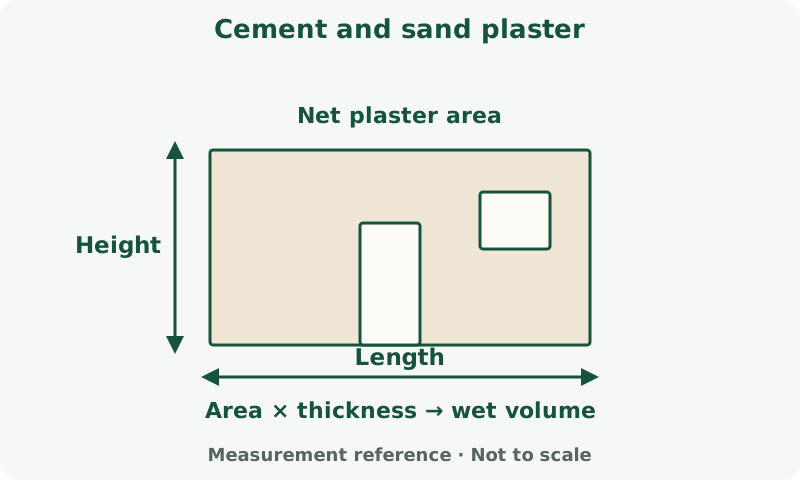
Start with measured wall faces
For an apartment, list each room's wall lengths and plastered height. Count both faces of an internal partition only when both actually receive this finish. Deduct doors, windows and surfaces excluded by the measurement rules you are using; measure their reveals separately if they are plastered.
Do not multiply a three-bedroom apartment's floor area by an unexplained factor. A compact plan, long corridor, double-height majlis and many partitions produce different wall areas. The worked example below assumes your measured net wall-face schedule totals 100 m².
From wet volume to dry constituents
Wet volume = area × thickness in metres. For a chosen volumetric ratio 1:s and dry factor F, cement volume = wet volume × F ÷ (1 + s); sand volume = wet volume × F × s ÷ (1 + s). To estimate cement mass, multiply cement volume by the chosen loose bulk density, then divide by the actual bag mass.
The example uses F = 1.33, cement loose bulk density = 1,440 kg/m³ and 50 kg cement bags. These are explicit quantity-model assumptions, not a prescribed recipe or manufacturer guarantee. Loose bulk density is not cement particle density. Replace assumptions with the approved mix, trial yield or product data when available.
Worked example: 100 m² at 15 mm, 1:4
Wet volume is 100 × 0.015 = 1.5 m³. Under the stated model, dry constituent volume is 1.5 × 1.33 = 1.995 m³. Cement volume is 1.995 ÷ 5 = 0.399 m³, giving 574.56 kg or 11.4912 bags of 50 kg. Sand is 1.596 m³.
With an illustrative 10% loss allowance applied once, cement becomes 632.016 kg and sand 1.7556 m³. Round 12.64032 bags up to 13. A 1:6 ratio would produce different constituent quantities; it is not a permitted substitution unless the specification allows it.
| Thickness | Wet volume | Cement to order | Loose sand model |
|---|---|---|---|
| 12 mm | 1.20 m³ | 11 bags | 1.4045 m³ |
| 15 mm | 1.50 m³ | 13 bags | 1.7556 m³ |
| 20 mm | 2.00 m³ | 17 bags | 2.3408 m³ |
Two coats and uneven substrates
If the same face receives two layers, calculate each layer's area and thickness, then add them. Do not enter the combined thickness and also multiply by two coats. Where the base is uneven, take enough thickness measurements to document an average or separate deeper patches.
A rush coat, bonding treatment, mesh, beads and finishing putty are separate products. Their consumption should come from the specific product data. External render and wet areas may have requirements that an internal wall plaster mix does not meet.
Premixed render uses a different purchasing method
For a factory-made render bag, use its published kg/m²/mm consumption or stated coverage at the specified thickness. Do not split a premix bag into cement and sand using the site-mix formula. The Sika GCC render reference below is an example of the kind of product sheet to obtain.
Round cement bags only at the end of the combined takeoff for a shared batch, while keeping sand delivery units clear. Sand moisture and bulking affect volumetric batching; your measured site yield is a stronger ordering input than a generic factor. Print the table with its assumptions so a buyer can check them.
Questions people ask
How many cement bags for plastering 100 m²?
At 15 mm, 1:4 and the explicitly stated model here, 13 whole 50 kg cement bags includes the example 10% allowance. A different thickness, yield, ratio or bag mass changes that number.
Can 1:6 replace 1:4?
Only when permitted by the approved specification. The calculator compares quantity arithmetic; it does not select a suitable plaster mix.
Does 100 m² mean the floor area?
No. It is the measured net wall or ceiling area actually receiving that plaster layer.
Sources and calculation basis
Source links support the specific technical points below. Worked quantities are Construclytic calculations using the assumptions shown above. References do not establish local prices or replace the project specification.
- Sika GCC: SikaWall-115 RenderManufacturer example of a cementitious ready-mix plaster. Its product instructions do not validate the generic site-mix assumptions above.