Calculated result
3.25yd³
Ready-mix order
Formula
CONC-SLAB-001L × W × D × quantity ÷ 27 × (1 + waste) → ready-mix order
80 ft³
Net volume
2.96 yd³
Net volume
0.33 loads
10 yd³ truck-load equivalent
Concrete calculator
Volume, ready-mix order, and bag equivalent for a rectangle, circle, or L-shape.
By Feroz Sheikh · Formula CONC-SLAB-001 v1.2.0 · Tested formula
CONC-SLAB-001v1.2.0Enter your measurements. Switching units converts the same project, including coverage and unit rates. Package yields keep the unit printed beside each field.
Calculated result
Ready-mix order
CONC-SLAB-001L × W × D × quantity ÷ 27 × (1 + waste) → ready-mix order
Net volume
Net volume
10 yd³ truck-load equivalent
Planning estimate, not engineering advice. Confirm site measurements and product specifications. Calculation limits.
Counts round up. A cubic yard is 45 of 80 lb, 60 of 60 lb, 72 of 50 lb, 90 of 40 lb.
| Bag | Count |
|---|---|
| 40 lb | 288 |
| 50 lb | 231 |
| 60 lb | 192 |
| 80 lb | 144 |
This calculator returns ready-mix order quantity and bag equivalents for a rectangle, circle, or L-shape slab, in metric or imperial units. Formula CONC-SLAB-001 v1.2.0. Waste and purchase rounding stay on the sheet. Drop the line into an estimate and send a quote letter.
Size chart
Rectangle pads. Example 8% allowance and this calculator's 0.25 yd³ rounding step, not a universal plant rule. At 4 in, 1 yd³ covers 81 ft² before allowance. Bag counts round up from allowance-adjusted volume, before ready-mix rounding. Confirm product yield and supplier increments.
| Size | Thickness | Ready-mix order | 40 lb | 60 lb | 80 lb |
|---|---|---|---|---|---|
| 10 × 10 ft | 4 in | 1.5 yd³ | 120 | 80 | 60 |
| 10 × 12 ft | 4 in | 1.75 yd³ | 144 | 96 | 72 |
| 12 × 12 ft | 4 in | 2 yd³ | 173 | 116 | 87 |
| 12 × 16 ft | 4 in | 2.75 yd³ | 231 | 154 | 116 |
| 16 × 16 ft | 4 in | 3.5 yd³ | 308 | 205 | 154 |
| 20 × 12 ft | 4 in | 3.25 yd³ | 288 | 192 | 144 |
| 20 × 20 ft | 4 in | 5.5 yd³ | 480 | 320 | 240 |
| 24 × 24 ft | 4 in | 7.75 yd³ | 692 | 461 | 346 |
| 30 × 30 ft | 4 in | 12 yd³ | 1080 | 720 | 540 |
| 10 × 10 ft | 6 in | 2 yd³ | 180 | 120 | 90 |
| 12 × 12 ft | 6 in | 3 yd³ | 260 | 173 | 130 |
| 20 × 20 ft | 6 in | 8 yd³ | 720 | 480 | 360 |
Metric example — 3 × 3 m at 100 mm. A 3 × 3 m rectangle at 100 mm with 8% waste is 0.9 m³ net and a 1 m³ ready-mix order. Bag mass stays an input; 80 lb is not the only package.
Bags vs bulk. Compare bag mixing time and equipment with a ready-mix quote, including minimum order, delivery, short-load and placement charges. There is no universal one-yard cost break-even. Choose one supply method; do not add the bag equivalent to the truck order.
Enter supplier prices and any labour, equipment or delivery costs. Pick a currency — badges, inputs, and totals follow.
Enter your supplier’s ready-mix concrete rate in the selected unit. Add delivery, pumping, short-load fees and placing labour as separate project costs. For GCC projects, select QAR, AED, SAR, KWD, OMR or BHD and enter local supplier rates.
How this calculator works
 Feroz SheikhWritten by Feroz Sheikh · founder
Use finished slab dimensions and depth to estimate net volume for a rectangle, circle, or L-shape, then apply a practical waste allowance before ready-mix purchase rounding.
Separate the concrete inside the forms from your purchase quantity: measure the shape, apply the allowance once, then check this calculator's 0.25 yd³ / 0.1 m³ rounding against your supplier's actual order increment. Bag counts use allowance-adjusted volume before ready-mix rounding, so they are an alternative supply method, not an extra order. Formula CONC-SLAB-001 keeps the arithmetic traceable.
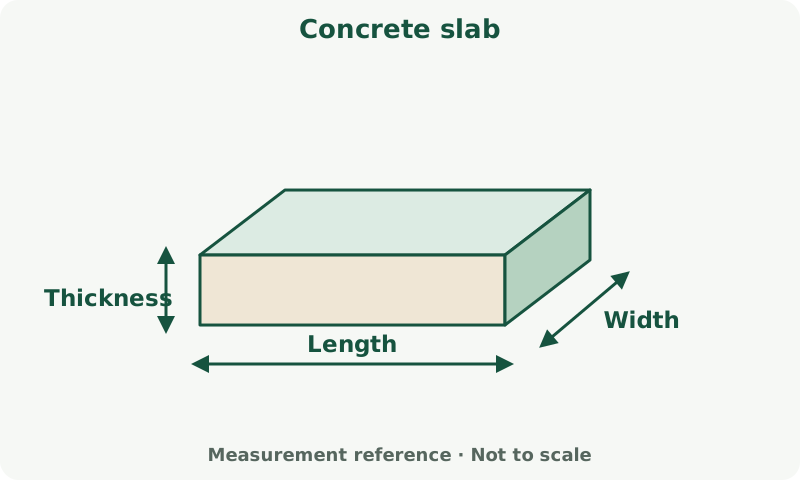
For a rectangular slab, cubic yards = length (ft) × width (ft) × thickness (in) ÷ 324. In metric, cubic metres = length (m) × width (m) × thickness (mm) ÷ 1,000. These are volume estimates, not thickness or structural recommendations.
| Stage | Calculation | Meaning |
|---|---|---|
| Net volume | 20 × 12 × (4 ÷ 12) = 80 ft³ | 2.962963 yd³ inside the forms |
| Add allowance once | 80 × 1.08 = 86.4 ft³ | 3.20 yd³ before purchase rounding |
| Ready-mix option | 3.20 rounded up to a 0.25 yd³ step | 3.25 yd³; confirm your supplier's increment |
| 80 lb bag option | 86.4 ÷ 0.60 = 144 | 144 whole bags at this assumed yield |
Choose bags or ready-mix, not both. The bag table uses allowance-adjusted net volume, not the rounded truck order. The 0.60 ft³ yield matches the approximate yield of QUIKRETE Concrete Mix 1101, 80 lb; it is not a promise for every 80 lb product. For a different yield, use the product-yield bag calculator.
The equivalent dimensions are 6.096 × 3.6576 m at 101.6 mm: 2.265348 m³ net, 2.446576 m³ with 8%, then 2.5 m³ using this tool's metric step. The bag count remains 144. Different rounded order volumes do not mean the underlying geometry changed.
NRMCA CIP 31 gives 4–10% contingency guidance above plan volume. Measure known extra volume first, then choose a site-specific allowance. Ask the supplier about ordering increments, minimum quantities and delivery charges.
This separate example uses the calculator's starting values in imperial units. It stays unchanged when you edit the tool above. Example rates, yields and dimensions are assumptions, not recommendations for your project.
| Input | Example value |
|---|---|
| Plan shape | Rectangle |
| Length | 20 ft |
| Width | 12 ft |
| Depth | 4 in |
| Number of slabs | 1 count |
| Waste factor | 8 % |
Example result: Ready-mix order — 3.25 yd³.
L × W × D × quantity ÷ 27 × (1 + waste) → ready-mix order
Use the labelled units above when reproducing this example. To work in metric, switch the calculator to Metric; applicable measurements are converted, while product-specific units remain labelled.
Metric mode uses metres for plan dimensions, millimetres for thickness and cubic metres for volume. Exactly 4 in is 101.6 mm, not 100 mm. Net volume converts between unit systems, but the final order can differ because this tool rounds separately to 0.25 yd³ or 0.1 m³; neither increment is a universal supplier rule.
Need the broader workflow? Read the concrete planning guide.
How-to: Concrete weight from volume: kilograms, tonnes and US tons · Curb and gutter concrete: calculate the cross-section first · Concrete stairs: separate step wedges, waist slab and landings · How to calculate a concrete slab · Ready-mix or bags: when each makes sense · Concrete slab cost: build an estimate from supplier quotes · Metric takeoffs for Qatar and the GCC · How to plan a slab rebar grid
Questions
This calculator rounds the allowance-adjusted volume up to 0.25 yd³ in imperial mode or 0.1 m³ in metric mode. These are its planning increments, not universal plant rules. Confirm the supplier's increment, minimum order and delivery charges before purchasing.
Compare the product's bag yield, mixing equipment and available labour with the supplier's delivered ready-mix quote and minimum order. There is no universal one-yard break-even. The bag and truck results are alternative ways to supply the same pour.
For QUIKRETE Concrete Mix 1101's approximate published yields, 1 yd³ (27 ft³) corresponds to 90 × 40 lb, 72 × 50 lb, 60 × 60 lb or 45 × 80 lb bags before any extra allowance. Other products may yield differently; check the bag label.
Use the thickness required by the project design and responsible professional. The 4 in starting example is not a recommendation for a driveway, garage or structural slab. Split areas of different thickness and avoid counting thickened edges twice.
Rectangle is L × W. Circle uses the diameter you type. L-shape subtracts the missing inner rectangle (notch length × notch width) from the outer box.
No. Confirm strength, reinforcement, thickness, local code, and mix with the responsible professional and the plant.
NRMCA CIP 31 discusses ordering 4–10% above estimated plan volume for contingencies. This tool starts at 8%, but that is an editable example, not a guarantee. Measure known extra concrete volume first, then agree an allowance for site and placement conditions with the supplier.
At 4 in thick, 1 yd³ covers 81 ft². That is the field “magic number”: square feet ÷ 81 ≈ yards for a 4 in slab, before waste.
No. It is a takeoff aid. Replace planning rates with supplier quotes, confirm dimensions on site, and treat the quote letter as a proposal until both parties sign.
The calculator does not retrieve live prices. Replace any example material rate with your supplier's quote in the selected currency and volume unit. Include delivery, minimum-order or short-load charges, pumping and labour separately when applicable.
A 10 × 10 ft rectangle at 4 in with 8% waste rounds to a 1.5 yd³ ready-mix order on a 0.25 yd³ step. At 4 in, 1 yd³ covers 81 ft² — that shortcut is a check, not a substitute for waste and plant rounding.
A 12 × 12 ft rectangle at 4 in with 8% waste orders 2 yd³.
A 20 × 20 ft rectangle at 4 in with 8% waste orders 5.5 yd³.
The same 10 × 10 ft pad at 4 in thick with 8% allowance is 60 bags, using 0.60 ft³ per 80 lb bag. Check your chosen product's yield. Bag counts are an alternative to, not an addition to, the ready-mix order.
This concrete slab calculator publishes formula CONC-SLAB-001, version 1.2.0. The ID stays on the result and on the estimate line.