
Worked example — 20 ft × 12 ft × 4 in, 8% waste
Net volume is 20 × 12 × (4 ÷ 12) = 80 ft³ = 2.96 yd³. With 8% waste that is 3.20 yd³, which rounds up to a 3.25 yd³ ready-mix order. The same pour is 288 of 40 lb bags or 144 of 80 lb bags if you mix by hand — a crew day, not a saving once you are past about a cubic yard.
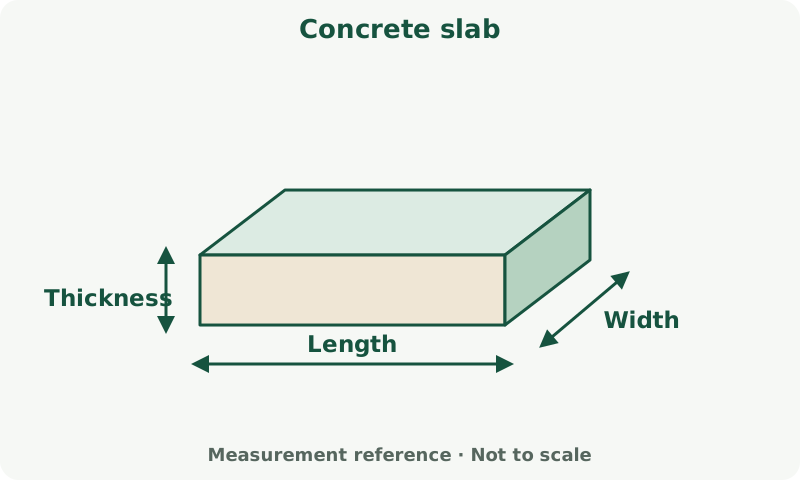
Measure the pad that will actually be placed
Use the finished length and width of the slab, not the excavation. A 20 ft × 12 ft garage pad that the forms hold at 20 × 12 is 240 ft², even if the overdig was larger. Depth is the design thickness — interior slabs are often 4 in, driveways 4–6 in, garage slabs 4–5 in with thicker edges. Confirm the spec; this method does not size the slab.
Split unlike thicknesses. A 4 in interior with a 12 in thickened edge is two prisms, or an edge takeoff plus the field, not one average depth.
- Rectangle: length × width × depth.
- Circle: π × (diameter ÷ 2)² × depth. Diameter is the finished span in feet, depth still in inches.
- L-shape: outer box minus the missing inner rectangle (notch length × notch width), then times depth.
Convert to cubic yards before you phone the plant
Cubic feet ÷ 27 = cubic yards. A 20 × 12 × 4 in rectangle is 80 ft³, which is 2.96 yd³ before waste. Ready-mix is sold in steps — commonly 0.25 yd³ in the US, 0.1 m³ metric — so a net figure is not an order.
Waste is its own input. 8% is a fair start on a rectangular pour with decent access. Pump lines, steps, and over-excavated grade all eat more. Shorting the truck costs more than a leftover yard.
What typical public calculators skip
A length × width × depth widget is not a takeoff if it hides waste, plant rounding and bag SKUs. Construclytic keeps formula CONC-SLAB-001 on the sheet so a quote letter from last month still explains the arithmetic. The L-shape subtracts the notch instead of averaging the pad into one fat rectangle.
Costs stay labelled as planning rates you type. There is no live Qatar or US plant feed. QAR, AED and SAR are display conversions of the same planning figure.
Metric and GCC jobs
Switch the calculator to metric rather than converting a cubic-yard ticket in your head. A 100 mm interior slab is the usual cousin of a 4 in US pad. Ready-mix in Doha and the wider GCC is sold in cubic metres, commonly rounded to 0.1 m³. 200 mm block walls are a masonry takeoff, not extra slab thickness.
Hot weather, pump lines and tight villa access eat waste. 8% is still only a start. Record the percentage so the next estimator can change it.
How much concrete for a 10×10, 12×12, 16×16 or 20×20 pad
These four tickets are 4 in rectangles with 8% waste, then ready-mix rounded up to a 0.25 yd³ plant step. Formula CONC-SLAB-001. Change thickness or waste on the calculator — do not scale these numbers by eye for a 6 in driveway or an L-shape.
- 10×10 × 4 in → 1.23 yd³ net, 1.50 yd³ order.
- 12×12 × 4 in → 1.78 yd³ net, 2.00 yd³ order.
- 16×16 × 4 in → 3.16 yd³ net, 3.50 yd³ order.
- 20×20 × 4 in → 4.94 yd³ net, 5.50 yd³ order.
Sources and limits
Bag yields follow common labelled volumes (about 0.60 ft³ for an 80 lb sack). Replace them with the sack in your hand. Volume geometry is the Concrete Network-style L × W × T method, then waste, then purchase rounding.
This is not a mix design, not a soil report, not reinforcement, and not a municipality approval. Confirm thickness, strength and joints with the responsible professional.
Do it in order
- Choose rectangle, circle or L-shape and enter finished dimensions. Keep thickness in inches.
- Apply a waste allowance that matches access and placement, not a hidden bump inside length.
- Round the waste-adjusted volume up to the plant increment, then decide bags or a truck.
| Bag | Nominal bags / yd³ | Yield |
|---|---|---|
| 40 lb | 90 | 0.30 ft³ |
| 50 lb | 72 | 0.375 ft³ |
| 60 lb | 60 | 0.45 ft³ |
| 80 lb | 45 | 0.60 ft³ |
Planning boundary
This is a quantity method. It does not set compressive strength, reinforcement, joint layout, soil bearing or a guaranteed plant price.
How much concrete for a 10x10 slab?
A 10×10 pad 4 in thick is 1.23 yd³ net. With 8% waste the ready-mix order rounds to 1.50 yd³. Thicker slabs, circles and L-shapes are not this ticket — open the calculator.
Do I enter thickness in feet?
No. Slab depth is inches (or millimetres in metric). Length and width are feet. Circle diameter is also feet.
Can I use one rectangle for an L-shape?
You will over-order. Enter the outer box and subtract the notch, or split the L into two rectangles and add them.
Is 8% waste always enough?
It is a start on a simple rectangle. Pumping, stairs, cold joints and poor access need more. Record the percentage so a later estimator can change it.