Quick answer
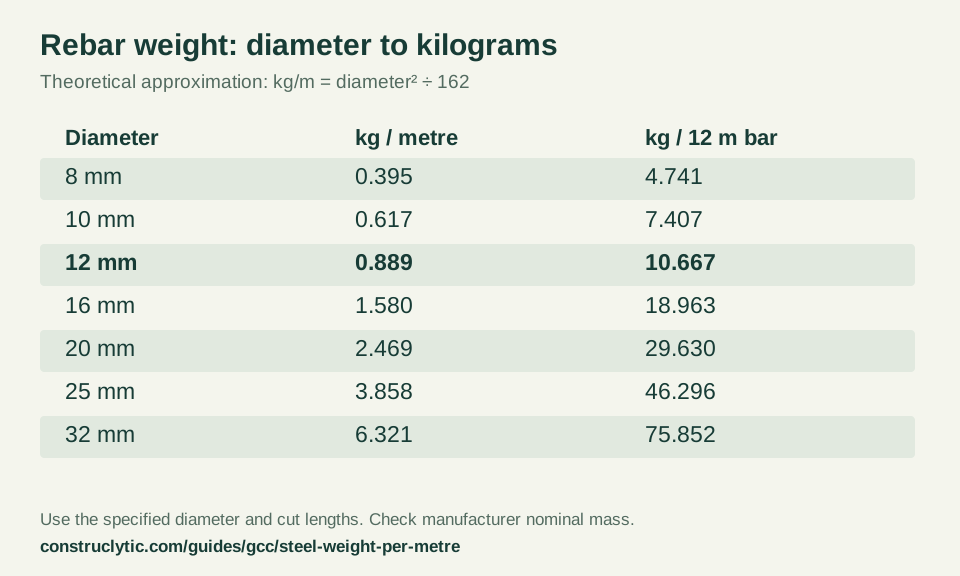
For a nominal round steel bar, kg/m ≈ D²/162 when D is in millimetres. A 12 mm bar is about 0.889 kg/m, or 10.667 kg for 12 m. Manufacturer nominal-mass tables may differ slightly through rounding and production tolerances.
Where D²/162 comes from
A round bar's cross-section is πD²/4. Convert the diameter from millimetres to metres, multiply the area by one metre of length and then by an assumed steel density of 7,850 kg/m³. That gives 0.0061654D² kg/m, close to D²/162.
The shortcut is theoretical mass for the nominal diameter. Manufacturer tables use nominal values and applicable tolerances. Use the supplier's documentation for the purchase and weighbridge reconciliation. A ribbed bar is identified by its nominal diameter; measuring across rib tips and treating that as a smooth solid cylinder is incorrect.
| Diameter | kg per metre | kg per 12 m bar |
|---|---|---|
| 8 mm | 0.395 | 4.741 |
| 10 mm | 0.617 | 7.407 |
| 12 mm | 0.889 | 10.667 |
| 16 mm | 1.580 | 18.963 |
| 20 mm | 2.469 | 29.630 |
| 25 mm | 3.858 | 46.296 |
| 32 mm | 6.321 | 75.852 |
Worked quantity example: a 12 mm grid
Consider an illustrative single-layer grid with bar centrelines at the boundaries of a 4 × 3 m centreline rectangle and maximum spacing 200 mm in both directions. Bars running 4 m long are spaced across 3 m: 3 ÷ 0.2 + 1 = 16. Bars running 3 m long are spaced across 4 m: 4 ÷ 0.2 + 1 = 21.
Total straight centreline length is 16 × 4 + 21 × 3 = 127 m. With the D²/162 shortcut, mass is 127 × 12² ÷ 162 = 112.89 kg. An illustrative 10% purchasing allowance makes it 139.7 m and 124.18 kg, but it does not calculate actual lap lengths or a cutting schedule.
The 4 × 3 m rectangle is explicitly a bar-centreline example, not the concrete edge. Actual cover, bends, anchorage, overlaps, starter bars, extra supports and multiple layers must be taken from the reinforcement drawings. The existing slab-grid tool uses US bar numbers; use the metric steel-weight tool for a true 12 mm weight.
12 m stock and a cutting schedule
Dividing total length by 12 m gives only a theoretical lower bound on stock bars. In the example, a single 12 m bar can provide three 4 m cuts or four 3 m cuts before considering cutting allowances, but mixing those cuts may leave unusable offcuts. Work through each required cut length and reuse policy.
Separate drawing laps from handling loss. A flat percentage cannot establish the lap length required at a given location. Price straight bars, cut-and-bent service, transport and waste separately where the supplier quotes them separately.
Why kg of steel per m³ is not a design rule
A slab, beam, column and footing carrying different loads can have very different reinforcement intensity. Structural system, spans, loading and detailing change the bar schedule. This guide intentionally supplies no universal kg/m³ reinforcement recommendation.
After a design schedule exists, you can divide its total reinforcement mass by the corresponding concrete volume as a project comparison ratio. Label the elements and revision. That historical ratio is useful for checking an estimate, but applying it to a new building does not replace its design.
Questions people ask
How much does a 12 mm, 12 m bar weigh?
The D²/162 shortcut gives 10.667 kg. Check the manufacturer's nominal mass and tolerances for the bar being purchased.
Is a US #4 bar the same as a 12 mm bar?
No. US bar designations are a different size system. Use the specified designation or metric diameter, not a visual substitute.
Can I order from total kg alone?
Include diameter, grade, lengths or bending schedule, quantity and required certification. An equal mass of the wrong size is not an equivalent reinforcement order.
Sources and calculation basis
Source links support the specific technical points below. Worked quantities are Construclytic calculations using the assumptions shown above. References do not establish local prices or replace the project specification.
- Qatar Steel: reinforcing steel product specificationsManufacturer reference for bar sizes and nominal mass. The worked grid below is an independent quantity example.