Quick answer
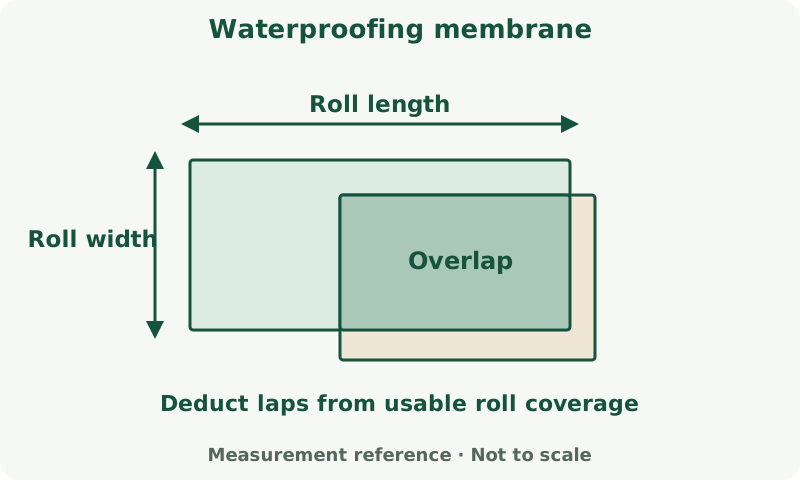
Effective repeated roll coverage ≈ (roll width − side lap) × (roll length − end lap). A 1 × 10 m roll with illustrative 100 mm side and 150 mm end laps covers about 8.865 m² in this conservative repeated-module model, before cutting and details.
Measure the complete waterproofed surface
Measure the roof field, then add waterproofed upstands, kerbs, parapets and other vertical surfaces. Openings may reduce field area but also introduce extra details. A drain outlet or penetration does not necessarily save material after reinforcement pieces and detailing are included.
For a sloped surface, use actual surface dimensions. Where multiple layers are required, count the specified layers and their separate roll types. Do not assume a two-layer assembly uses one product or an identical lap layout everywhere.
Worked example: 100 m² field plus upstands
Suppose the roof field is 100 m², the waterproofed upstand length is 40 m and its height is 0.3 m. The additional face area is 12 m², so the one-layer area is 112 m². With an illustrative 5% cutting allowance, the quantity model uses 117.6 m².
For 1 × 10 m rolls with assumed 0.10 m side laps and 0.15 m end laps, repeated-module coverage is 0.90 × 9.85 = 8.865 m². Divide 117.6 by 8.865 to get 13.2657 rolls; round to 14 whole rolls. This conservative area model is not a complete cutting layout.
A layout may recover some perimeter laps or require more offcuts, corner pieces and reinforcement. Check the result against actual roll courses and all specified details before purchasing. If there are two identical layers, calculate the combined demand before package rounding or document separate product orders.
Use the exact membrane's installation data
The 100/150 mm laps above are an example, not a universal waterproofing rule. The cited Sika product illustrates such lap dimensions for that specific membrane. Your roof's membrane may require different dimensions, end treatments, stagger, substrate preparation or installation conditions.
Primer, protection board, insulation, fillets, drainage outlets, termination bars, sealants and flood-test provisions are separate items. A roll count cannot verify adhesion, drainage or system compatibility.
Compare complete supplier offers
Record product name, thickness or mass designation, reinforcement, finish, roll dimensions, number of layers and compatible accessories. Ask for current product data, shelf-life and storage requirements, delivery and the agreed warranty scope.
Price whole rolls using a dated local quote. Keep labour, substrate preparation, repairs, accessories and testing separate unless clearly included. Photograph and document the accepted substrate and completed details as required by the project quality process.
Questions people ask
Does a 10 m² roll cover 10 m² of roof?
Usually the gross roll area exceeds installed coverage because of laps and cuts. Use the selected product's lap dimensions and layout.
Is 100 mm overlap always enough?
No. Follow the actual manufacturer's data and the project specification for side laps, end laps and details.
Does this calculator select a waterproofing system?
No. It estimates the quantity of the system already specified, including explicit laps, layers and additional measured area.
Sources and calculation basis
Source links support the specific technical points below. Worked quantities are Construclytic calculations using the assumptions shown above. References do not establish local prices or replace the project specification.
- Sika: SikaShield P24 MG 4.5 kg/m²A specific product example with 100 mm side and 150 mm end laps; not a blanket specification for GCC roofing.