On this page
Quick answerThese ratios are for a budget, before the drawings existRanges read from the published tablesThe sources do not agree, and that is the pointWorked example: a 10 × 8 m slab, 200 mm thickCheck the mass with D²/162Order from the scheduleQuick answer
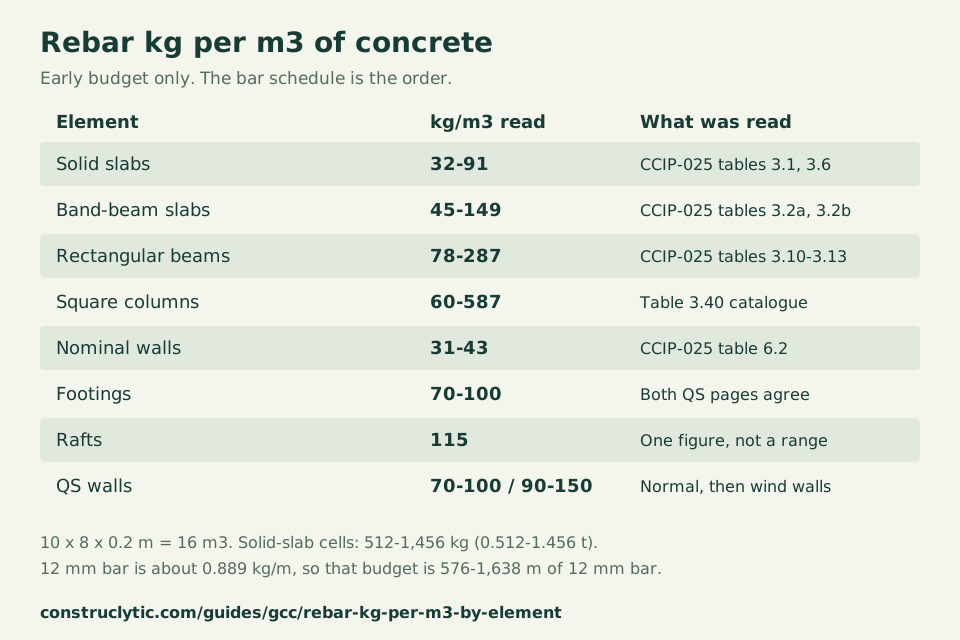
A concrete slab needs 32–91 kg of steel per m³ when solid, or 45–149 kg/m³ on a band beam; a rectangular beam needs 78–287 kg/m³, and square columns in the same catalogue run from 60 to 587 kg/m³. Budget mass in kilograms = concrete volume in cubic metres × a chosen kilograms-per-cubic-metre ratio. A 10 × 8 m slab at 0.2 m is 16 m³. At the solid-slab cells checked below, 32–91 kg/m³ is 512–1,456 kg, or 0.512–1.456 tonnes. That is an early budget, not a bar bending schedule and not a structural design.
These ratios are for a budget, before the drawings exist
Kilograms of rebar per cubic metre of concrete is a comparison ratio: total reinforcement mass divided by the concrete volume of the same element. It does not choose bar diameter, spacing, cover, laps or anchorage. The quantity that gets ordered is the bar bending schedule on the structural drawings.
MPA The Concrete Centre's 2009 handbook, Economic Concrete Frame Elements to Eurocode 2 (CCIP-025), says its reinforcement densities are for very preliminary comparison and should not be used for contractual estimates of tonnage. The cells below were read from that handbook's tables. Quantity-surveyor pages publish different guideline bands for the same element names. Where they disagree, both figures are shown.
Ranges read from the published tables
The Concrete Centre cells are for in-situ C30/37 concrete and fyk = 500 MPa reinforcement, with the handbook's stated fire, exposure and load limits. Slab and beam densities include calculated laps and curtailment and exclude wastage, except Table 6.2 walls, whose footnote includes 20% for laps and wastage. A blank cell in a source table was not invented.
Solid one-way and two-way slabs in Tables 3.1a, 3.1b, 3.6a and 3.6b, for spans of 4–12 m and imposed loads of 2.5–10 kN/m², run from 32 to 91 kg/m³. One-way slabs on wide band beams in Tables 3.2a and 3.2b, over the same spans and loads, run from 45 to 149 kg/m³. Rectangular beams 300 mm or 600 mm wide in Tables 3.10 to 3.13, spans 4–12 m and ultimate uniform loads of 25–200 kN/m where a cell is published, run from 78 to 287 kg/m³.
Table 3.40 is a catalogue of square-column bar arrangements, not a recommended ratio. The cells read there run from 60 kg/m³ (8H16 in a 600 mm column) to 587 kg/m³ (8H40). A worked scheme in the same book uses about 435 kg/m³ at the lowest storey of one internal column and then an estimating average of 300 kg/m³, and 240 kg/m³ as an average in another case. Table 6.2 gives nominal wall reinforcement of 31–43 kg/m³ for 140–350 mm walls under vertical load and nominal eccentricity. The handbook does not cover foundations.
| Element | kg/m³ read | Source and limit |
|---|---|---|
| Solid slabs | 32–91 | CCIP-025 Tables 3.1 and 3.6, spans 4–12 m, imposed load 2.5–10 kN/m² |
| Band-beam slabs | 45–149 | CCIP-025 Tables 3.2a and 3.2b, same spans and loads |
| Rectangular beams | 78–287 | CCIP-025 Tables 3.10–3.13, 300 or 600 mm wide |
| Square columns | 60–587 | CCIP-025 Table 3.40 bar catalogue, not a design band |
| In-situ walls, nominal bars | 31–43 | CCIP-025 Table 6.2, includes 20% laps and wastage |
| Footings | 70–100 | Prova Surveying and YourSpreadsheets agree; CCIP-025 has no footings |
| Rafts | 115 | One published figure on both QS pages, not a range |
| QS beams | 100–150 and 150–350 | YourSpreadsheets splits light beams; Prova states 250–350 |
| QS columns | 110–450 | YourSpreadsheets 110–200 light, else 200–450; Prova 200–450 |
| QS walls | 70–100 or 90–150 | Both QS pages: normal walls, then wind walls |
The sources do not agree, and that is the point
Prova Surveying and YourSpreadsheets agree on footings at 70–100 kg/m³, rafts at 115 kg/m³, one-way slabs at 75–125, two-way slabs at 67–135 and plate slabs at 95–135. Those slab bands sit inside the wider Concrete Centre span-and-load tables. They do not agree on beams. Prova states 250–350 kg/m³. YourSpreadsheets states 100–150 kg/m³ for lightly loaded beams and 150–300 kg/m³ otherwise. Their notes for extra steel on exposed elements also differ, so those uplifts are not applied here.
One Click LCA reprints a UK-style table in the Prova pattern, including beams at 250–350 kg/m³, and separately lists Finnish averages of 100 kg of ordinary rebar per cubic metre for a reinforced concrete beam, 100 kg/m³ for a column, and 35 kg/m³ for an internal wall element about 180 mm thick. The Finnish wall figure is close to Table 6.2. The Finnish beam and column figures are far below Prova's bands. Use the row that matches the source you are comparing, and say which one it is.
Worked example: a 10 × 8 m slab, 200 mm thick
Volume = 10 × 8 × 0.2 = 16 m³. This example uses only the solid-slab cells, 32–91 kg/m³, because a band-beam slab in Tables 3.2a and 3.2b can be higher. Low budget mass = 16 × 32 = 512 kg = 0.512 tonnes. High budget mass = 16 × 91 = 1,456 kg = 1.456 tonnes. No cutting waste is added: those slab cells already exclude wastage, and a second percentage would invent one.
The same 16 m³ at the QS one-way band of 75–125 kg/m³ would be 1,200–2,000 kg, and at the two-way band of 67–135 kg/m³ it would be 1,072–2,160 kg. Those are different publications, not a tighter answer. Measure the real slab, including beams and drops, in the concrete slab calculator before you multiply.
Check the mass with D²/162
For a nominal round bar, kilograms per metre ≈ D²/162 when D is in millimetres. A 12 mm bar is 144 ÷ 162 = 0.889 kg/m. Dividing the solid-slab budget by that rate gives length, not a layout: 512 ÷ (144/162) = 576 m of 12 mm bar, and 1,456 ÷ (144/162) = 1,638 m. An equal mass of 16 mm bar is a different length and a different design.
The steel weight per metre page keeps the chart and the density assumption. Manufacturer nominal mass can differ slightly from the shortcut. The rebar calculator counts a grid only after spacing, cover and bar size are entered. Neither tool turns 512 kg into a schedule. Dated prices per ton are in rebar price per ton in the UAE and rebar price per ton in Saudi Arabia.
Order from the schedule
A budget ratio is useful while the drawings are still open and you need a tonne allowance for a cost plan. Once a revision exists, add the cut lengths, bends, laps and chairs from that revision and throw the ratio away for the order. Keep the concrete volume and the steel mass labelled with the element and the drawing number if you want the project's own kg/m³ later.
This page is not a design to Eurocode 2, ACI 318 or Qatar Construction Specifications, and it does not set a minimum or maximum reinforcement ratio. Seismic detailing, exposure, spans and loading move the real quantity outside every band above.
Questions people ask
How many kg of steel per m3 of concrete slab beam column?
A concrete slab needs 32–91 kg of steel per m³ when solid, or 45–149 kg/m³ on a band beam; a rectangular beam needs 78–287 kg/m³, and square columns in the same catalogue run from 60 to 587 kg/m³. Budget mass in kilograms = concrete volume in cubic metres × a chosen kilograms-per-cubic-metre ratio.
How many kilograms of steel are in one cubic metre of concrete slab?
In the Concrete Centre tables checked here, solid slabs are about 32–91 kg/m³ and one-way slabs on wide band beams are about 45–149 kg/m³. QS pages put one-way slabs at 75–125 kg/m³ and two-way slabs at 67–135 kg/m³. The bar schedule decides the real quantity.
How much rebar does a concrete beam need per cubic metre?
The rectangular-beam cells checked in CCIP-025 run from 78 to 287 kg/m³. Prova Surveying states 250–350 kg/m³, and YourSpreadsheets states 100–150 kg/m³ for lightly loaded beams and 150–300 kg/m³ otherwise. They disagree.
What is a typical steel ratio for a footing or a raft?
CCIP-025 does not publish foundation ratios. Prova Surveying and YourSpreadsheets both give footings as 70–100 kg/m³ and rafts as 115 kg/m³. Treat 115 as one published figure, not a range you can stretch.
Can I order reinforcement from kilograms per cubic metre?
No. The ratio is an early budget. The order needs diameter, grade, cut lengths or a bending schedule, and the drawing revision. An equal mass of the wrong bar is not the same reinforcement.
How do I check steel weight with D squared over 162?
Kilograms per metre ≈ D²/162 for D in millimetres. A 12 mm bar is 0.889 kg/m, so 512 kg is 576 m of that bar and 1,456 kg is 1,638 m. The formula converts mass to length. It does not choose the bars.
Sources and calculation basis
Source links support the points named beside them. Worked quantities are Construclytic calculations using the assumptions shown above. A price in a table is the figure that source printed on the date it was read. It is not a quotation for your site, and it does not replace the project specification.
- MPA The Concrete Centre: Economic Concrete Frame Elements to Eurocode 2 (CCIP-025, 2009)Goodchild, Webster and Elliott, ISBN 1-904818-54-4. Cells checked on 20 October 2026 from Tables 3.1, 3.2, 3.6, 3.10–3.13, 3.40 and 6.2. Pre-scheme densities only; the book excludes foundations and warns against contractual tonnages.
- EU Joint Research Centre: bibliographic record for the same handbookConfirms authors, publisher and that the 2009 book updates the earlier BS 8110 edition. It does not reprint the tables.
- Prova Surveying: reinforcement estimatesQS guideline table. Footings 70–100, rafts 115, beams 250–350, columns 200–450, normal walls 70–100, wind walls 90–150 kg/m³. Exposed-element uplifts on this page differ from YourSpreadsheets and are not applied.
- YourSpreadsheets: reinforcement estimatesAgrees with Prova on footings, rafts and the slab rows cited above. Splits beams into 100–150 and 150–300 kg/m³, and columns into 110–200 and 200–450 kg/m³.
- One Click LCA: average quantities of reinforcement in concreteHelp article dated 12 March 2025. Reprints a UK-style table and, separately, Finnish averages of 100 kg/m³ for a reinforced concrete beam, 100 kg/m³ for a column and 35 kg/m³ for an internal wall element.
- Qatar Steel: reinforcing steel product specificationsManufacturer reference for nominal bar mass. It is not the source of the kg/m³ budget ranges.