On this page
Quick answerPublished square-mesh weightsSheet weight is kilograms per square metre times 11.52Sheets equal the slab area divided by the effective sheet area, rounded upWorked example: a 6 m × 4 m slabWorked example: a 10 m × 10 m slabA142 and A193 are different meshes, not a house-slab ruleOrder the mesh after the concrete volume, not instead of itQuick answer
A standard 4.8 m × 2.4 m A193 sheet weighs 34.7904 kg, because the published mass is 3.02 kg/m² and the sheet area is 4.8 × 2.4 = 11.52 m². With a 200 mm lap taken off each edge of the repeat, one sheet covers 10.12 m². A 10 × 10 m slab needs 15 of those sheets when offcuts are not reused, which is 521.856 kg of A193 or 383.616 kg of A142.
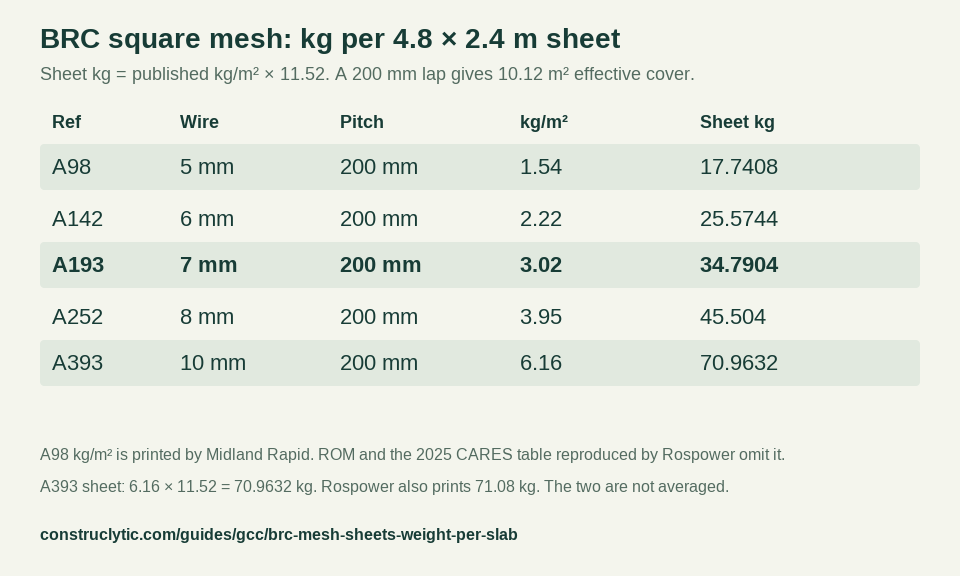
Published square-mesh weights
BRC is the name people search for factory-welded square fabric. The designations below are the square meshes in supplier tables made to BS 4483: the same wire diameter and a 200 mm pitch in both directions. ROM's brochure, checked 28 October 2026, says the group manufactures mesh to BS 4483:1998 and BS 4483:2005, and its standard-fabric chart is for a 4.8 m × 2.4 m sheet. That chart prints A393 at 6.16 kg/m², A252 at 3.95, A193 at 3.02 and A142 at 2.22. It does not print A98.
Midland Rapid Reinforcements prints the same four kilograms-per-square-metre figures for a 4.8 m × 2.4 m sheet, and it also prints A98 at 1.54 kg/m² with 5 mm wires at 200 mm. Rospower's mesh calculator, updated 1 September 2026 and checked on 28 October 2026, says its mass column is the 2025 CARES guide table based on BS 4483:2025. That column matches 6.16, 3.95, 3.02 and 2.22 kg/m² and does not list A98. A98 stays in the table because Midland Rapid prints it. It is not described here as a 2025 CARES designation.
| Designation | Wire diameter | Spacing | kg/m² | kg per 4.8 × 2.4 m sheet |
|---|---|---|---|---|
| A98 | 5 mm | 200 mm | 1.54 | 17.7408 |
| A142 | 6 mm | 200 mm | 2.22 | 25.5744 |
| A193 | 7 mm | 200 mm | 3.02 | 34.7904 |
| A252 | 8 mm | 200 mm | 3.95 | 45.504 |
| A393 | 10 mm | 200 mm | 6.16 | 70.9632 |
Sheet weight is kilograms per square metre times 11.52
The stock sheet on the ROM chart and on the Midland Rapid page is 4.8 m by 2.4 m. Its area is 4.8 × 2.4 = 11.52 m². Sheet weight on this page is the published kg/m² multiplied by 11.52, before any rounding a catalogue applies to the sheet cell. A98 is 1.54 × 11.52 = 17.7408 kg. A142 is 2.22 × 11.52 = 25.5744 kg. A193 is 3.02 × 11.52 = 34.7904 kg. A252 is 3.95 × 11.52 = 45.504 kg. A393 is 6.16 × 11.52 = 70.9632 kg.
ROM prints the sheet cells as 25.57 kg, 34.79 kg, 45.50 kg and 70.96 kg. Midland Rapid prints 17.74 kg, 25.57 kg, 34.79 kg, 45.5 kg and 70.96 kg. Those are the same products of 11.52 rounded to two decimal places, with 45.5 written without the trailing zero. Rospower prints 25.57 kg, 34.79 kg and 45.50 kg for A142, A193 and A252, and 71.08 kg for the A393 stock sheet. 6.16 × 11.52 is 70.9632 kg, not 71.08 kg, so both figures stay visible and they are not averaged. Merchant sheets, flying-end sheets and purpose-made mats are different areas. Do not multiply 11.52 for a 3.6 m × 2.0 m sheet.
Sheets equal the slab area divided by the effective sheet area, rounded up
The one-line count is sheets = ceil(slab area ÷ effective sheet area). Effective area is what one sheet adds after the lap, not the 11.52 m² printed on the bundle. Reinforcement Products Online, checked 28 October 2026, quotes the Eurocode 2 minimum lap as l0,min ≥ max{0.3 α6 lb,rqd; 15φ; 200 mm}. The 200 mm term is the floor of that expression, not the lap the drawing will specify, and not a substitute for the anchorage calculation. The worked sheets on this page use 200 mm only as that published floor.
Deduct 200 mm from each side of the 4.8 m × 2.4 m sheet. The repeat is (4.8 − 0.2) × (2.4 − 0.2) = 4.6 × 2.2 = 10.12 m². That is the effective cover used below. A longer lap from the drawing makes both sides shorter and the sheet count higher. ROM's flying-end note, on the same brochure, says those splices are detailed for a minimum lap of 40 times the bar diameter. That sentence is about flying-end fabric, so it is not applied to the plain sheet edges in the examples.
Dividing by 10.12 m² assumes the reduced sheet tiles the slab. A whole-sheet grid that does not reuse offcuts can need more sheets, because a leftover strip in one direction is not a leftover strip in the other. Rospower states the grid as 1 + ceil((span − sheet) ÷ (sheet − lap)) in a direction that is longer than the sheet, and 1 sheet when the span already fits. Total sheets are the two directions multiplied, for one layer. A top layer and a bottom layer are two orders.
Worked example: a 6 m × 4 m slab
The slab area is 6 × 4 = 24 m². The area formula gives ceil(24 ÷ 10.12) = ceil(2.3715…) = 3 sheets. The same three sheets come from the grid if the 4.8 m side lies along the 4 m side: 4 m fits inside 4.8 m, so that direction is 1 sheet. The 6 m side uses the 2.4 m edge: 1 + ceil((6 − 2.4) ÷ (2.4 − 0.2)) = 1 + ceil(3.6 ÷ 2.2) = 1 + ceil(1.6363…) = 3. The order is 1 × 3 = 3 sheets.
Turn the sheet the other way and the count rises. Along 6 m with the 4.8 m edge: 1 + ceil((6 − 4.8) ÷ 4.6) = 1 + ceil(1.2 ÷ 4.6) = 2. Along 4 m with the 2.4 m edge: 1 + ceil((4 − 2.4) ÷ 2.2) = 1 + ceil(1.6 ÷ 2.2) = 2. That layout is 4 sheets. The lower whole-sheet layout for this rectangle is 3. At that count, A142 is 3 × 25.5744 = 76.7232 kg and A193 is 3 × 34.7904 = 104.3712 kg. Neither figure includes chairs, tie wire or a second layer.
| Mesh | Sheets | kg per sheet | Total kg |
|---|---|---|---|
| A142 | 3 | 25.5744 | 76.7232 |
| A193 | 3 | 34.7904 | 104.3712 |
Worked example: a 10 m × 10 m slab
The slab area is 10 × 10 = 100 m². The area formula gives ceil(100 ÷ 10.12) = ceil(9.8814…) = 10 sheets. The whole-sheet grid is larger. Along the 4.8 m edge: 1 + ceil((10 − 4.8) ÷ 4.6) = 1 + ceil(5.2 ÷ 4.6) = 1 + ceil(1.1304…) = 3. Along the 2.4 m edge: 1 + ceil((10 − 2.4) ÷ 2.2) = 1 + ceil(7.6 ÷ 2.2) = 1 + ceil(3.4545…) = 5. The square is the same if the sheet is rotated, so the order is 3 × 5 = 15 sheets when offcuts are not reused.
Fifteen sheets is the count to order for one layer under that rule. A142 is 15 × 25.5744 = 383.616 kg. A193 is 15 × 34.7904 = 521.856 kg. The 10-sheet area result would be 255.744 kg of A142 or 347.904 kg of A193, and it is short of the grid because the offcut on the long edge does not fill the short edge. With no lap at all, 100 ÷ 11.52 is 8.6805…, which rounds up to 9 sheets. That 9 is the gross-sheet count in the wire-mesh calculator when sheet coverage is 11.52 m² and the waste field is 0. It is not the lapped order.
| Count | A142 total kg | A193 total kg |
|---|---|---|
| 15 sheets, grid, offcuts not reused | 383.616 | 521.856 |
| 10 sheets, ceil(100 ÷ 10.12) | 255.744 | 347.904 |
A142 and A193 are different meshes, not a house-slab rule
A142 is 6 mm wire at 200 mm in both directions and 2.22 kg/m². A193 is 7 mm wire at 200 mm in both directions and 3.02 kg/m². On one 4.8 m × 2.4 m sheet that is 25.5744 kg against 34.7904 kg. The extra mass is the extra steel area in the designation, 142 mm²/m against 193 mm²/m on the ROM chart. It is not a recommendation to use either mesh in a house slab.
A ground-floor slab, a suspended slab and a blinding are different members. Cover, layers, laps and the mesh reference belong on the structural drawing. This page does not choose A142 or A193, and it does not convert a kilogram-per-cubic-metre budget into a mesh. Those published ranges, and where the sources disagree, are in rebar kilograms per cubic metre. Bar mass for a schedule that uses loose bars is in steel weight per metre.
Order the mesh after the concrete volume, not instead of it
A 10 × 10 m slab at 150 mm is 10 × 10 × 0.15 = 15 m³ of concrete before any allowance. That volume does not contain the 383.616 kg or the 521.856 kg above. Measure it in the concrete slab calculator. The GCC construction guides collect the other quantity pages. The mesh order is designation, sheet size, sheet count, layer count and the lap the drawing states.
The wire mesh calculator divides slab area by the coverage you type, then applies a percentage in the waste field and rounds up to a whole sheet. Put 11.52 in coverage only when you mean the gross 4.8 m × 2.4 m sheet and you will add the lap yourself. Put 10.12 in coverage, with waste at 0, only when you want the area formula on this page. For the 10 × 10 m grid, order 15 sheets rather than the 9 or 10 those two entries return.
Questions people ask
How many BRC sheets for a 10x10 slab?
Fifteen standard 4.8 m × 2.4 m sheets, for one layer, when the lap is 200 mm and offcuts are not reused: 3 sheets along the 4.8 m edge and 5 along the 2.4 m edge. Dividing 100 m² by the 10.12 m² effective sheet gives 10, which is short of that grid. A second layer doubles the 15.
What is the weight of A193 mesh?
A193 is 7 mm wire at 200 mm centres and 3.02 kg/m² on the ROM, Midland Rapid and Rospower tables opened for this page. A 4.8 m × 2.4 m sheet is 3.02 × 11.52 = 34.7904 kg. ROM and Midland Rapid print 34.79 kg, which is that product rounded to two decimal places.
A142 vs A193, which for a house slab?
This page does not choose. A142 is 6 mm at 200 mm and 2.22 kg/m², so one 4.8 m × 2.4 m sheet is 25.5744 kg. A193 is 7 mm at 200 mm and 3.02 kg/m², so the same sheet is 34.7904 kg. The drawing names the mesh, the layers and the lap.
What is the weight of an A142 sheet?
2.22 kg/m² × 11.52 m² = 25.5744 kg for a 4.8 m × 2.4 m sheet. ROM, Midland Rapid and Rospower all print 2.22 kg/m², and they print the sheet as 25.57 kg.
What is the weight of A393 mesh per sheet?
6.16 kg/m² × 11.52 m² = 70.9632 kg. ROM and Midland Rapid print 70.96 kg for the 4.8 m × 2.4 m sheet. Rospower's reproduction of the 2025 CARES table prints 71.08 kg for the same stock sheet. The two sheet figures are both shown and are not averaged.
Sources and calculation basis
Source links support the points named beside them. Worked quantities are Construclytic calculations using the assumptions shown above. A price in a table is the figure that source printed on the date it was read. It is not a quotation for your site, and it does not replace the project specification.
- ROM: fabric mesh brochure, standard fabric chartOpened 28 October 2026. The fabric-mesh pages say ROM manufactures mesh to BS 4483:1998 and BS 4483:2005. The standard fabric chart is for a 4.8 m × 2.4 m sheet: A393 10 mm at 200 mm, 6.16 kg/m², sheet 70.96 kg; A252 8 mm, 3.95 kg/m², 45.50 kg; A193 7 mm, 3.02 kg/m², 34.79 kg; A142 6 mm, 2.22 kg/m², 25.57 kg. A98 is not on that chart. The flying-end note says those splices allow a minimum lap of 40 times the bar diameter, and that sentence is not used as the lap for a plain sheet.
- Midland Rapid Reinforcements: standard fabric to BS 4483Opened 28 October 2026. Standard size sheets 4.8 m × 2.4 m. Square mesh: A393 6.16 kg/m² and 70.96 kg; A252 3.95 kg/m² and 45.5 kg; A193 3.02 kg/m² and 34.79 kg; A142 2.22 kg/m² and 25.57 kg; A98 5 mm at 200 mm, 1.54 kg/m² and 17.74 kg. No publication date is printed on the table. A98 is included from this page only.
- Rospower: reinforcement mesh calculator, BS 4483 weightsOpened 28 October 2026. The page says it was updated 1 September 2026 and that the mass column is the 2025 CARES guide table based on BS 4483:2025. A393 6.16 kg/m² and a 71.08 kg stock sheet; A252 3.95 kg/m² and 45.50 kg; A193 3.02 kg/m² and 34.79 kg; A142 2.22 kg/m² and 25.57 kg. A98 is absent. 71.08 kg is not 6.16 × 11.52.
- Reinforcement Products Online: lapping mesh reinforcementOpened 28 October 2026. States that standard mesh sheets are 2.4 m × 4.8 m. Quotes the Eurocode 2 minimum lap as l0,min ≥ max{0.3 α6 lb,rqd; 15φ; 200 mm}. The 200 mm term is the floor used for the worked sheet count, not a designed lap length.