On this page
Quick answerVolume is area times thickness, then a dry factorPer square metre, before wasteWorked example: a 4 × 5 m room at 50 mmBonded, unbonded and floating thicknessesA weight ratio is not this volume splitWhat the order leaves outQuick answer
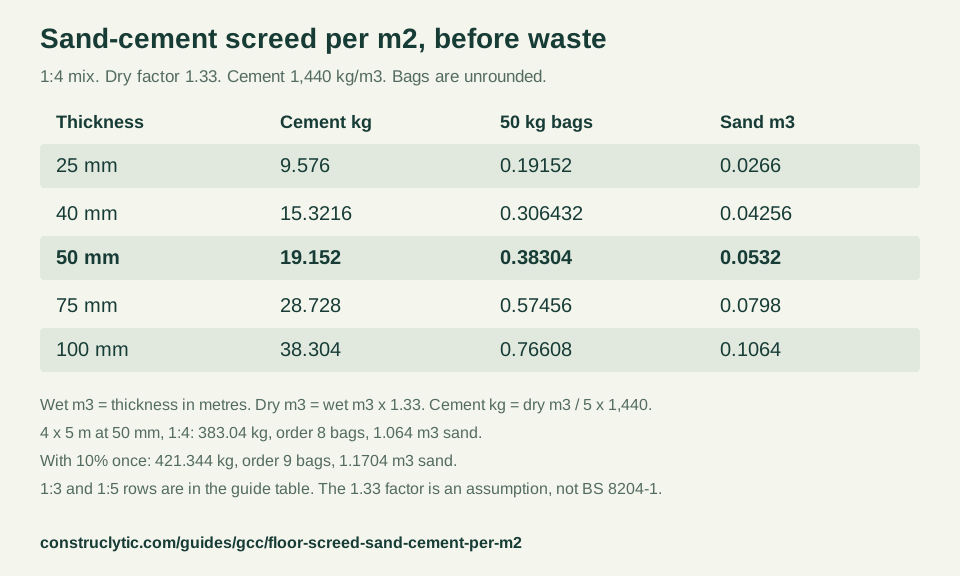
One square metre of sand-cement screed at 50 mm is 0.050 m³ of mix. For a 1:4 loose-volume split, with dry factor 1.33 and cement at 1,440 kg/m³, that square metre needs 19.152 kg of cement, which is 0.38304 of a 50 kg bag, and 0.0532 m³ of sand, before any waste. At 75 mm the same mix is 0.075 m³, 28.728 kg of cement, 0.57456 of a bag, and 0.0798 m³ of sand.
Volume is area times thickness, then a dry factor
Wet volume in cubic metres = area in square metres × thickness in metres. Dry volume = wet volume × 1.33. For a mix written 1:s, cement volume = dry volume ÷ (1 + s) and sand volume = dry volume × s ÷ (1 + s). Cement kilograms = cement volume × 1,440. Unrounded 50 kg bags = cement kilograms ÷ 50. Round bags up only after the whole floor is added, not on each square metre.
The 1.33 factor is an explicit assumption, the same editable factor as the plaster calculator. It stands in for voids in loose cement and sand. It is not printed in the Concrete Society screed note, in MPA Mortar data sheet 22, or in BS 8204-1 as those pages describe the standard. Replace it with a measured trial batch when you have one. Do not also use the 1.54 dry factor from cement, sand and aggregate for 1 m³. That model includes coarse aggregate, and a sand-cement screed does not. The 1,440 kg/m³ figure is the loose bulk density in the ESE Civil 2015 solution, which reports 50 ÷ 1,440 = 34.72 litres and rounds that to 35 litres. It is not cement particle density. Plaster cement and sand uses the same pair of assumptions for a wall coat.
Per square metre, before waste
At 25 mm the wet volume is 0.025 m³ and the dry volume is 0.03325 m³. At 40 mm those volumes are 0.040 m³ and 0.0532 m³. At 50 mm they are 0.050 m³ and 0.0665 m³. At 75 mm they are 0.075 m³ and 0.09975 m³. At 100 mm they are 0.100 m³ and 0.133 m³. Cement kilograms are that dry volume divided by the number of parts, then multiplied by 1,440. A 1:4 mix has 5 parts, so the 50 mm row is 0.0665 ÷ 5 × 1,440 = 19.152 kg, and 19.152 ÷ 50 = 0.38304 bags.
Sand for 1:3 and 1:4 terminates. Sand for 1:5 is dry volume × 5 ÷ 6, and dividing by 6 does not terminate. Those cells are rounded half up to 8 decimal places: 0.0665 × 5 ÷ 6 = 0.05541666…, written 0.055417. The same rule writes 0.02770833, 0.04433333 and 0.11083333. A 1:3 row at 50 mm is 0.0665 ÷ 4 × 1,440 = 23.94 kg. A 1:5 row is 0.0665 ÷ 6 × 1,440 = 15.96 kg. None of these cells includes waste.
| Thickness | Mix | Wet m³ | Cement kg | 50 kg bags, unrounded | Sand m³ |
|---|---|---|---|---|---|
| 25 mm | 1:3 | 0.025 | 11.97 | 0.2394 | 0.0249375 |
| 25 mm | 1:4 | 0.025 | 9.576 | 0.19152 | 0.0266 |
| 25 mm | 1:5 | 0.025 | 7.98 | 0.1596 | 0.02770833 |
| 40 mm | 1:3 | 0.040 | 19.152 | 0.38304 | 0.0399 |
| 40 mm | 1:4 | 0.040 | 15.3216 | 0.306432 | 0.04256 |
| 40 mm | 1:5 | 0.040 | 12.768 | 0.25536 | 0.04433333 |
| 50 mm | 1:3 | 0.050 | 23.94 | 0.4788 | 0.049875 |
| 50 mm | 1:4 | 0.050 | 19.152 | 0.38304 | 0.0532 |
| 50 mm | 1:5 | 0.050 | 15.96 | 0.3192 | 0.05541667 |
| 75 mm | 1:3 | 0.075 | 35.91 | 0.7182 | 0.0748125 |
| 75 mm | 1:4 | 0.075 | 28.728 | 0.57456 | 0.0798 |
| 75 mm | 1:5 | 0.075 | 23.94 | 0.4788 | 0.083125 |
| 100 mm | 1:3 | 0.100 | 47.88 | 0.9576 | 0.09975 |
| 100 mm | 1:4 | 0.100 | 38.304 | 0.76608 | 0.1064 |
| 100 mm | 1:5 | 0.100 | 31.92 | 0.6384 | 0.11083333 |
Worked example: a 4 × 5 m room at 50 mm
The floor is 4 × 5 = 20 m². Wet volume is 20 × 0.050 = 1.000 m³. Dry volume is 1.000 × 1.33 = 1.330 m³. At 1:4, cement volume is 1.330 ÷ 5 = 0.266 m³, which is 0.266 × 1,440 = 383.04 kg, or 383.04 ÷ 50 = 7.6608 bags. Order 8 bags of 50 kg if this room is the whole purchase. Sand is 1.330 × 4 ÷ 5 = 1.064 m³. The cement-and-sand calculator, with waste left at 0, returns that 383.04 kg and the 8-bag order.
A waste allowance is separate from the 1.33 factor. This example uses 10% once, on the unrounded room total: 383.04 × 1.10 = 421.344 kg, which is 8.42688 bags, ordered as 9. Sand becomes 1.064 × 1.10 = 1.1704 m³. Dry volume with that allowance is 1.330 × 1.10 = 1.463 m³. Do not add 10% to each square metre in the table and then again to the room. The calculator’s waste field multiplies the dry volume once, which is the same product as multiplying the wet volume once and then applying 1.33. Put 10 in that field only when you want this allowance. Round the bags once, at the end of the combined order.
| Line | Calculation | Quantity |
|---|---|---|
| Net area | 4 × 5 | 20 m² |
| Wet volume | 20 × 0.050 | 1.000 m³ |
| Dry volume | 1.000 × 1.33 | 1.330 m³ |
| Cement, 1:4 | 1.330 ÷ 5 × 1,440 | 383.04 kg |
| 50 kg bags, unrounded | 383.04 ÷ 50 | 7.6608 |
| Bags to order | round 7.6608 up | 8 |
| Sand | 1.330 × 4 ÷ 5 | 1.064 m³ |
| With 10% once | 383.04 × 1.10 | 421.344 kg, 9 bags, 1.1704 m³ sand |
Bonded, unbonded and floating thicknesses
The quantity rows are not a thickness specification. The Concrete Society, in a note published on 3 June 2025 and citing BS 8204, Screeds, bases and in-situ floorings (2004), says the optimum thickness of a sand and cement bonded screed is 25–40 mm, an unbonded screed should have a minimum thickness of 50 mm, and a floating screed should have a thickness greater than 65 mm for lightly loaded floors and 75 mm for more heavily loaded floors. It also says a minimum of 65 mm is possible when the insulation boards are firm enough for compaction. Proprietary screeds, the same note says, can be laid thinner than conventional sand-cement screed.
MPA Mortar data sheet 22, issue 3, October 2023, uses a different sentence for the same three constructions. It says a bonded screed should have a minimum thickness of 25 mm and that 40 mm should normally be specified to accommodate deviations in the base. An unbonded screed should be at least 50 mm, and 70 mm should be specified to allow for those deviations. A floating screed should be at least 75 mm, although 65 mm is normally considered satisfactory for domestic housing. The two pages do not agree on one floating figure or on a single unbonded design thickness, so this guide shows both and does not average them. A 65 mm or 70 mm screed is not an extra row. Scale the 50 mm row by 65 ÷ 50 or 70 ÷ 50. At 1:4 that is 19.152 × 1.3 = 24.8976 kg at 65 mm, and 19.152 × 1.4 = 26.8128 kg at 70 mm, still before waste.
A weight ratio is not this volume split
MPA Mortar data sheet 22 says that, before BS EN 13813, screeds in the United Kingdom were specified by prescription, and that BS 8204-1 recommends nominal proportions by weight of cement to fine aggregate of 1:4, with a lower limit of 1:3 and an upper limit of 1:4.5. The sheet says a screed produced with those proportions would meet the expected criteria for in-situ crushing resistance, and that a compressive strength class of C20 or C25 would also meet that requirement. For fine concrete levelling screeds, with aggregate up to 10 mm, the sheet says the standard recommends proportions in the range 1:4 to 1:5.
Those ratios are by weight. Every mix column on this page is a loose-volume split. A volume ratio matches a weight ratio only when cement and sand have the same bulk density. This page does not adopt a sand density, so it does not convert the BS weight limits into the table. Do not label a 1:4 volume row as a BS 8204-1 screed, and do not treat 1:3, 1:4 or 1:5 as a strength class. The drawing, or the screed supplier’s declared mix, chooses the proportions. This arithmetic only splits a volume you have already measured.
What the order leaves out
Tile laid on the screed is a different product. Notch and back-butter kilograms are in tile adhesive per square metre. Mortar in a block joint is in mortar for a block wall per square metre. The other quantity pages are on the GCC construction guides. A self-levelling sack is not this site mix. Its yield is the figure printed on the bag, and the self-level calculator divides the floor area by that yield. Published bag counts from 50 to 500 sq ft, including a 25 kg table, are in self-leveler bags per square foot. Services buried in the screed, falls, and a second layer are extra volume. Measure them. Do not hide them inside the waste percentage.
No price is stated. A 50 kg bag is the purchase unit in the formula because 50 ÷ 1,440 is the bulk volume in the ESE solution, not because a supplier’s rate was copied. Apply one waste allowance to the whole floor after the table, then round 50 kg bags up once. Sand stays in cubic metres until the supplier’s bulk density converts it to tonnes. The concrete mix calculator still adds coarse aggregate at a dry factor of 1.54. That is a different material from the rows above.
Questions people ask
How many bags of cement for 50 mm screed per m²?
Before waste, 0.38304 of a 50 kg bag, which is 19.152 kg, for a 1:4 loose-volume mix at dry factor 1.33 and 1,440 kg/m³. The wet mix is 0.050 m³ and the sand is 0.0532 m³. A 1:3 mix is 0.4788 of a bag (23.94 kg) and a 1:5 mix is 0.3192 of a bag (15.96 kg). Order whole bags from the room total, not from one square metre.
How much sand and cement for a 75 mm floor screed per m²?
At 75 mm the wet volume is 0.075 m³. For 1:4, before waste, that is 28.728 kg of cement, 0.57456 of a 50 kg bag, and 0.0798 m³ of sand. For 1:3 it is 35.91 kg and 0.0748125 m³ of sand. For 1:5 it is 23.94 kg and 0.083125 m³ of sand.
How much screed do I need for a 4x5 m room at 50 mm?
The room is 20 m² and 1.000 m³ of wet mix. At 1:4, dry factor 1.33 and 1,440 kg/m³, before waste, that is 383.04 kg of cement, 7.6608 bags ordered as 8, and 1.064 m³ of sand. With 10% once it is 421.344 kg, 9 bags, and 1.1704 m³ of sand.
What is the minimum thickness of a bonded, unbonded or floating screed?
The Concrete Society, citing BS 8204, says 25–40 mm is the optimum bonded thickness, 50 mm is the unbonded minimum, and a floating screed should be greater than 65 mm for light loads and 75 mm for heavier loads. MPA Mortar data sheet 22 says specify 40 mm bonded, 70 mm unbonded where the base deviates, and 75 mm floating, with 65 mm normally satisfactory for domestic housing. This page does not choose among those sentences.
Is 1:4 screed by volume the same as the BS 8204 mix?
No. MPA Mortar data sheet 22 says BS 8204-1 states the proportions by weight, nominally 1:4, between 1:3 and 1:4.5. The table here is a loose-volume split at an assumed dry factor of 1.33. It is not a compliance claim.
Sources and calculation basis
Source links support the points named beside them. Worked quantities are Construclytic calculations using the assumptions shown above. A price in a table is the figure that source printed on the date it was read. It is not a quotation for your site, and it does not replace the project specification.
- Concrete Society: Screeds – generalOpened 29 October 2026. The page says it was published on 3 June 2025 and that screeds are covered by BS 8204, Screeds, bases and in-situ floorings (2004). Optimum sand-cement bonded thickness 25–40 mm. Unbonded minimum 50 mm. Floating thickness greater than 65 mm for lightly loaded floors and 75 mm for more heavily loaded floors, with 65 mm possible when the insulation is firm enough to compact the screed. Proprietary screeds can be thinner. The page does not state a dry-volume factor or a cement bulk density.
- MPA Mortar: data sheet 22, screedsOpened 29 October 2026. Data sheet 22, CI/SfB Yq4, issue 3, October 2023, which supersedes issue 2, September 2021. Bonded minimum 25 mm, normally specify 40 mm. Unbonded minimum 50 mm, specify 70 mm for base deviations. Floating minimum 75 mm, with 65 mm normally satisfactory for domestic housing. BS 8204-1 proportions by weight: nominal cement to fine aggregate 1:4, lower limit 1:3, upper limit 1:4.5. Fine concrete levelling screeds 1:4 to 1:5. The sheet does not state a dry-volume factor of 1.33 or a cement density of 1,440 kg/m³.
- ESE Civil 2015: bulk volume of a 50 kg cement bagOpened 29 October 2026. The published solution takes the bulk density of a cement bag as 1,440 kg/m³, so 50 ÷ 1,440 = 34.72 litres, reported as 35 litres. That density is the assumption in the table. It is not taken from BS 8204-1.