On this page
Quick answerThe kilogram comes from the notch and the productBags for 10, 25 and 50 m² at the UAE notch ratesBack-buttering, and the three porcelain sizesWorked example: 25 m² of 60×60 porcelainDo not treat a larger tile as automatically more adhesiveQuick answer
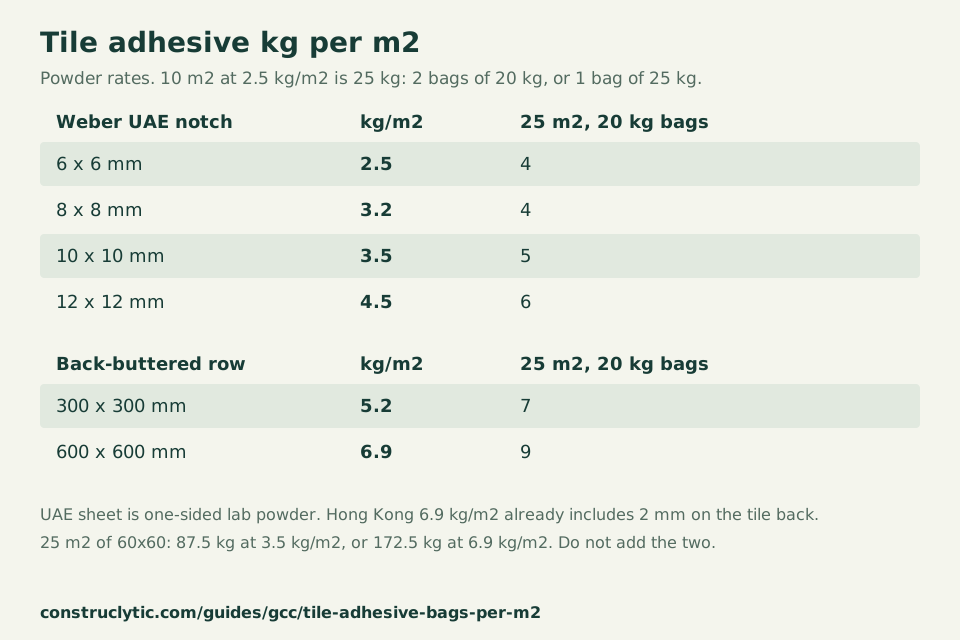
One square metre needs 2.5 kg of tile adhesive at a 6×6 mm notch, or 0.125 of a 20 kg bag before rounding up. Weber webercol premium, UAE sheet edition 07.20-A, is 2.5 kg of powder per square metre with a 6×6 mm notch. Ten square metres at that rate is 25 kg: 2 bags of 20 kg, or 1 bag of 25 kg. At the same 2.5 kg/m², 25 m² is 62.5 kg, which is 4 bags of 20 kg. The same sheet is 3.2, 3.5 and 4.5 kg/m² at 8×8, 10×10 and 12×12 mm. A 300 × 300 mm tile with 2 mm of back-buttering is 5.2 kg/m² on the Weber Hong Kong sheet, and a 600 × 600 mm tile is 6.9 kg/m².
The kilogram comes from the notch and the product
Weber webercol premium, sold as a 25 kg bag in the UAE sheet edition 07.20-A, prints powder consumption from lab trials: 2.5 kg/m² with a 6×6 mm notch (10 m² per bag), 3.2 kg/m² with 8×8 mm (7.8 m²), 3.5 kg/m² with 10×10 mm (7.2 m²) and 4.5 kg/m² with 12×12 mm (5.6 m²). Dividing 25 kg by the kilogram rate does not reproduce the printed coverage for the 8, 10 and 12 mm rows, because those square-metre figures are rounded. The orders below use the kilogram column. The sheet says the rates vary with substrate level and regularity. It does not add a second waste percentage.
LATICRETE 254 Platinum, a 50 lb (22.7 kg) bag, prints 7.4–8.8 m² with a 6 × 6 mm square notch and 3.2–3.7 m² with a 12 × 12 mm square notch. That is 22.7 ÷ 8.8 to 22.7 ÷ 7.4, or 2.58–3.07 kg/m², and 22.7 ÷ 3.7 to 22.7 ÷ 3.2, or 6.14–7.09 kg/m². The sheet has no 8 mm or 10 mm square-notch row. MAPEI Keraflex in the UAE sheet (106-7-2020), also a 25 kg bag, prints 2 kg/m² for trowel no. 4, 2.5–3 kg/m² for trowel no. 5 and 4 kg/m² for trowel no. 6. It does not state those trowel numbers in millimetres, so they are not forced onto the 6/8/10/12 table. The products disagree because they are different powders, not because one arithmetic is wrong.
Bags for 10, 25 and 50 m² at the UAE notch rates
None of the sheets opened here is a 20 kg bag. Weber’s UAE bag is 25 kg, MAPEI Keraflex UAE is 25 kg, LATICRETE 254 Platinum is 22.7 kg, and Weber Hong Kong weberset fast fix is packed as 40 kg. A 20 kg count is the printed kilograms divided by 20 and rounded up. It is the answer to the bag-size question, not a package the data sheet sells. Do not also multiply by the thinset calculator’s default 10% unless you have decided that allowance is extra to the lab rate.
Ten square metres at 2.5 kg/m² is exactly one 25 kg bag and 1.25 bags of 20 kg, so you buy 2. The thinset calculator opens on 10 m² with a coverage of 10 m² per bag and zero extra, which is that one 25 kg bag. Change the coverage when the notch changes. Tile cartons are a different count on the tile calculator. How many boxes a room needs for 60×60 cm tile is in 60×60 tile boxes for a room.
| Notch | kg/m² | 10 m², 20 kg | 10 m², 25 kg | 25 m², 20 kg | 25 m², 25 kg | 50 m², 20 kg | 50 m², 25 kg |
|---|---|---|---|---|---|---|---|
| 6×6 mm | 2.5 | 2 | 1 | 4 | 3 | 7 | 5 |
| 8×8 mm | 3.2 | 2 | 2 | 4 | 4 | 8 | 7 |
| 10×10 mm | 3.5 | 2 | 2 | 5 | 4 | 9 | 7 |
| 12×12 mm | 4.5 | 3 | 2 | 6 | 5 | 12 | 9 |
Back-buttering, and the three porcelain sizes
A 30×30 cm tile is 900 cm², a 60×60 cm tile is 3,600 cm² and a 120×60 cm tile is 7,200 cm². MAPEI Keraflex UAE says to spread adhesive on the back of the tile when the tile is larger than 900 cm², and also for exterior floors and walls, floors that are levelled during fixing, heavy loads, and pools. The 30×30 tile is not larger than 900 cm², so that one sentence does not require back-buttering; the 60×60 and 120×60 tiles are past it. The sheet does not print the extra kilograms. Weber UAE recommends back-buttering for external work, large tiles, or when optimal bonding is required, and its table still has one rate per notch. LATICRETE 254 Platinum says to back-butter tiles larger than 8 × 8 in (200 × 200 mm). All three of these sizes are larger than that. Its coverage sentence says the printed area varies with notch, tile and substrate. It does not add a second kilogram rate for the back coat.
Weber Hong Kong weberset fast fix does print the back-butter thickness. Consumption on that sheet is total thickness in millimetres × 1.15 kg/m² per mm. The 300 × 300 × 10 mm row is a 6 mm notch, 2 mm back-buttering, 4.5 mm total thickness and 5.2 kg/m². The 600 × 600 × 15 mm row is an 8–10 mm notch, 2 mm back-buttering, 6 mm total and 6.9 kg/m². The 1,000 × 1,000 mm row is a 10–12 mm notch, the same 2 mm back-buttering, and again 6.9 kg/m². A 120×60 cm tile is not on the sheet. The two published neighbours, 600×600 and 1,000×1,000, are both 6.9 kg/m², so that is the figure used below and it is labelled as the neighbour, not as a 120×60 test.
| Tile on the sheet | kg/m² | 10 m², 20 kg | 25 m², 20 kg | 50 m², 20 kg | 40 kg bags for 25 m² |
|---|---|---|---|---|---|
| 300×300, use for 30×30 | 5.2 | 3 | 7 | 13 | 4 |
| 600×600, use for 60×60 | 6.9 | 4 | 9 | 18 | 5 |
| 120×60, not listed; neighbours are 6.9 | 6.9 | 4 | 9 | 18 | 5 |
Worked example: 25 m² of 60×60 porcelain
If the notch in use is the UAE 10×10 mm row, and you do not add back-buttering on top of that lab rate, 25 × 3.5 = 87.5 kg. That is 87.5 ÷ 20 = 4.375, so 5 bags of 20 kg, or 87.5 ÷ 25 = 3.5, so 4 bags of 25 kg. If you follow the Hong Kong row for a 600 × 600 mm tile, 25 × 6.9 = 172.5 kg. That is 9 bags of 20 kg, 7 bags of 25 kg, or 5 bags of the 40 kg pack that sheet actually sells (172.5 ÷ 40 = 4.3125).
The same 25 m² is 87.5 kg or 172.5 kg because one rate is a one-sided lab trial and the other is a different product whose row already includes 2 mm on the back of the tile. Adding the UAE 3.5 kg/m² and then another back-butter percentage would invent a third number. Grout in the joints is not part of either rate: use the grout quantity guide and the grout calculator. Block-wall laying mortar is the other guide, mortar for a block wall. The sand-cement layer under the tile, when it is a screed rather than adhesive, is in sand-cement floor screed per square metre.
Do not treat a larger tile as automatically more adhesive
On the UAE sheet the kilogram changes with the notch, and the sheet never assigns 30×30, 60×60 or 120×60 to a notch. On the Hong Kong sheet a larger tile moves the recommended notch and adds a back-butter thickness, but the 600×600 and 1,000×1,000 rows land on the same 6.9 kg/m² because both are held at 6 mm total thickness. A bigger tile can use more adhesive. It does not have to, once the trowel and the back coat are already at the row the manufacturer printed.
The older thinset bags guide tells you to enter the coverage for the product you will buy. This page is the set of rates behind that instruction for these notches and these three sizes. Substrate flatness, the tile’s back profile and a notch held at the wrong angle move the real consumption off every row above. Check a tile, as LATICRETE says, and look at the transfer.
Questions people ask
How many 20kg bags of tile adhesive per m2?
One square metre needs 2.5 kg of tile adhesive at a 6×6 mm notch, or 0.125 of a 20 kg bag before rounding up; 10 m² is 2 whole bags of 20 kg. Bags = tiled area × the printed kg/m² ÷ bag mass, rounded up once. At 2.5 kg/m², 25 m² is 62.5 kg, which is 4 bags of 20 kg.
How many 20 kg bags of tile adhesive for 10 square metres?
Ten square metres at 2.5 kg/m² is 25 kg. That is 1.25 bags of 20 kg, so you buy 2. The Weber UAE sheet sells a 25 kg bag, and the same rate fills that bag exactly once.
How many kilograms of tile adhesive do I need per square metre?
On the Weber UAE sheet, a 6×6 mm notch is 2.5 kg/m², 8×8 mm is 3.2, 10×10 mm is 3.5 and 12×12 mm is 4.5. LATICRETE 254 Platinum converts to about 2.58–3.07 kg/m² at 6 mm and 6.14–7.09 kg/m² at 12 mm. With 2 mm of back-buttering, the Weber Hong Kong sheet is 5.2 kg/m² for 300×300 mm tile and 6.9 kg/m² for 600×600 mm tile.
How many 20 kg bags of tile adhesive do I need for 25 square metres?
At 2.5 kg/m², 25 m² is 62.5 kg, which is 4 bags of 20 kg. At 3.5 kg/m² it is 87.5 kg, which is 5 bags. At the 6.9 kg/m² back-buttered row it is 172.5 kg, which is 9 bags. The 20 kg bag is a conversion. The UAE sheet sells 25 kg.
Do I have to back-butter 60×60 porcelain?
MAPEI Keraflex UAE says yes when the tile is larger than 900 cm², and 60×60 is 3,600 cm². LATICRETE 254 Platinum says yes above 200×200 mm. Weber UAE recommends it for large tiles and does not print a second rate. The Hong Kong sheet puts 600×600 at 6.9 kg/m² including 2 mm on the back.
Does a 30×30 tile use the same adhesive as a 120×60 tile?
Not by size alone. The UAE notch table has no tile-size column. The Hong Kong sheet puts 300×300 at 5.2 kg/m² and both 600×600 and 1,000×1,000 at 6.9 kg/m². A 120×60 tile is not listed there; those neighbours are the closest published rows.
Is grout included in the adhesive kilograms?
No. The rates are for the adhesive bed. Joint grout is a separate material and a separate calculator. Blockwork laying mortar is a different guide as well.
Sources and calculation basis
Source links support the points named beside them. Worked quantities are Construclytic calculations using the assumptions shown above. A price in a table is the figure that source printed on the date it was read. It is not a quotation for your site, and it does not replace the project specification.
- Weber Middle East: webercol premium technical data sheet, edition 07.20-AOpened 21 October 2026. Powder rates 2.5, 3.2, 3.5 and 4.5 kg/m² for 6×6, 8×8, 10×10 and 12×12 mm notches, and the printed m² per 25 kg bag. Back-buttering is recommended for external work, large tiles or optimal bonding. The consumption note says lab rates vary with the substrate.
- LATICRETE: 254 Platinum data sheet DS-677.0-1017Opened 21 October 2026. 22.7 kg bag: 7.4–8.8 m² at 6×6 mm and 3.2–3.7 m² at 12×12 mm. Back-butter tiles larger than 200×200 mm. Coverage varies with notch, tile and substrate.
- MAPEI UAE: Keraflex technical data sheet 106-7-2020Opened 21 October 2026. 25 kg bag. Trowel no. 4 is 2 kg/m², no. 5 is 2.5–3 kg/m², no. 6 is 4 kg/m². Notch size in millimetres is not stated. Back-butter tiles larger than 900 cm², and the other cases named on the sheet.
- Weber Hong Kong: weberset fast fix product data sheet, September 2020Opened 21 October 2026. Consumption = total thickness (mm) × 1.15 kg/m²/mm. 300×300 mm is 5.2 kg/m² with 2 mm back-buttering. 600×600 mm and 1,000×1,000 mm are both 6.9 kg/m². Packed in 40 kg bags.