On this page
Quick answerThe litres are the joint, not the wallSolid beds and hollow face shellsA field rule that does not match the minimum shellWorked example: 100 m² of 200 mm solid blockWhat this order does not includeQuick answer
On a 400 × 200 mm module with 10 mm joints, a solid 200 mm wall holds 14.750 litres of mortar per square metre before waste, or 16.225 litres with 10% once. Face-shell bedding on the ASTM C90 minimum shells for a hollow 200 mm unit is 4.720 litres before that allowance. For 100 m² of the solid wall at 1:4, the loose-volume model orders 13 bags of 50 kg cement at either 1,440 or 1,506 kg/m³. At 1:6 the same wall orders 9 bags at 1,440 kg/m³ and 10 bags at 1,506 kg/m³.
The litres are the joint, not the wall
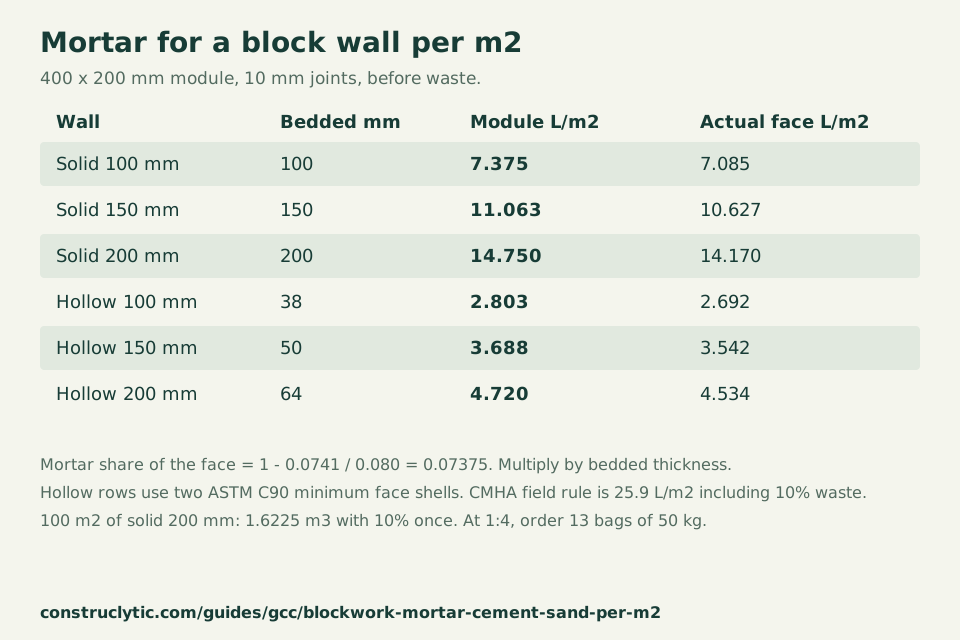
Bedded thickness is the full wall thickness for a solid bed, and only the two face shells for ordinary hollow-block bedding. Module area for a 400 × 200 mm module is 0.400 × 0.200 = 0.080 m², so the wall has 12.5 blocks/m². With a 10 mm joint the block face inside that module is 390 × 190 mm, or 0.0741 m². The mortar share of the face is 1 − 0.0741 ÷ 0.080 = 0.07375. Multiply by the bedded thickness in metres. That is the net joint volume per square metre of wall, with no waste in it yet.
CMHA’s shapes note says specified unit dimensions are typically 3/8 in (9.5 mm) less than the nominal module so the joint keeps the module. A GCC order written as 400 × 200 mm is often that module, not the US 406 × 203 mm nominal 16 × 8 in face. If the supplier instead means an actual 400 × 200 mm face plus 10 mm joints, the module is 410 × 210 mm and the mortar share of the face is 6,100 ÷ 86,100. Count the blocks on blocks per square metre before you price the mortar. The same face, in either reading, does not change with the 100, 150 or 200 mm thickness.
Solid beds and hollow face shells
A solid row below fills the bed and the head across the full thickness. ASTM C90 defines a solid unit as at least 75% of the gross area in every plane parallel to the bearing surface, so a unit sold as solid can still have small cores. The solid row is the full-thickness bed, not a claim that every core is absent. Hollow rows use face-shell bedding only. ASTM C90 Table 1, as summarised by CMHA for nominal widths, sets the minimum face shell at 3/4 in (19 mm) up to 4 in (102 mm), 1 in (25 mm) at 6 in (152 mm), and 1 1/4 in (32 mm) at 8 in (203 mm) and greater. Two shells are 38, 50 and 64 mm. Webs beside a grouted cell are extra mortar and are not in the table.
These shells are minima. A thicker shell, a flared top, or mortar squeezed out of the joint uses more. The 10 mm joint is the GCC figure used here; CMHA’s US joint in the same rule is 3/8 in, which they state as 9.5 mm. Do not add a second joint on top of a dimension the supplier already calls nominal. Plaster on the finished face is a coat, not this joint: plaster cement and sand.
| Wall | Bedded thickness | Module 400 × 200, L/m² | Actual face 400 × 200, L/m² |
|---|---|---|---|
| Solid 100 mm | 100 mm | 7.375 | 7.085 |
| Solid 150 mm | 150 mm | 11.063 | 10.627 |
| Solid 200 mm | 200 mm | 14.750 | 14.170 |
| Hollow 100 mm | 38 mm | 2.803 | 2.692 |
| Hollow 150 mm | 50 mm | 3.688 | 3.542 |
| Hollow 200 mm | 64 mm | 4.720 | 4.534 |
A field rule that does not match the minimum shell
CMHA TEK 03-11 says typical concrete masonry uses about 8.5 ft³ (0.24 m³) of mortar for every 100 ft² (9.3 m²). That is 25.9 litres per square metre. The note assumes 3/8 in joints, face-shell bedding, and a 10% waste allowance already inside the 8.5. TEK 04-02A says a face-shell estimate of this kind does not change with the width of the unit. The geometric hollow 200 mm row is 4.720 litres before waste, or 5.192 litres after a separate 10%. The published field rule is several times the minimum-shell geometry.
The gap is expected. The geometry uses the minimum shell and a perfect 10 mm joint, with nothing left on the board and nothing squeezed out. CMHA also notes that face shells taper, so the top of the unit is wider where the mortar is spread. A 100 mm hollow wall and a 200 mm hollow wall are equal in the field rule and unequal in the minimum-shell table. Say which figure you are ordering from. Do not add another 10% to the 8.5 ft³ number. The mortar calculator uses a different published rule, 5.5 ft³ per 100 ft², for modular brick and 8 in CMU bed joints. It is not this table.
Worked example: 100 m² of 200 mm solid block
Use the module column. Net volume is 100 × 0.014750 = 1.475 m³. One 10% allowance, applied once, gives 1.6225 m³. The loose-volume factor used here is 1.33, the same editable factor as the plaster calculator: dry volume = 1.6225 × 1.33 = 2.157925 m³. It stands in for voids in loose cement and sand. It is not printed in CMHA TEK 04-02A or in ASTM C270, so it stays an assumption you can replace with a trial batch. For 1:4, cement volume is 2.157925 ÷ 5 = 0.431585 m³ and sand is 1.726 m³.
Cement mass depends on which bulk density you take. At 1,440 kg/m³, cement is 621.482 kg, which is 12.430 bags of 50 kg, ordered as 13. At the CMHA figure of 1,506 kg/m³, cement is 649.967 kg, which is 12.999 bags, still ordered as 13. For 1:6 on the same dry volume, cement is 2.157925 ÷ 7 = 0.308275 m³: 443.916 kg or 8.878 bags at 1,440 kg/m³, ordered as 9, and 464.262 kg or 9.285 bags at 1,506 kg/m³, ordered as 10. The two densities disagree on that whole-bag count. Sand for 1:6 is 1.850 m³. Round bags once, at the end, for the whole order.
| Mix | kg at 1,440 | Bags at 1,440 | kg at 1,506 | Bags at 1,506 | Sand m³ |
|---|---|---|---|---|---|
| 1:4 | 621.482 | 13 | 649.967 | 13 | 1.726 |
| 1:5 | 517.902 | 11 | 541.639 | 11 | 1.798 |
| 1:6 | 443.916 | 9 | 464.262 | 10 | 1.850 |
What this order does not include
A 1:4, 1:5 or 1:6 cement:sand ratio is a quantity split, not a mortar type. ASTM C270 proportion mortars are cement-lime-sand or masonry-cement mixes, and CMHA’s yield table is in those terms: one 94 lb (42.6 kg) bag of portland cement, at the density they print as 1,506 kg/m³, lays about 62 hollow units in a lean Type S or rich Type N batch with lime. That is not 1:4. Qatar National Cement sells ordinary Portland cement in 50 kg bags; the 50 kg unit is the purchase unit, and it does not choose the density. At 1,440 kg/m³ a 50 kg bag is 34.7 litres. At 1,506 kg/m³ it is 33.2 litres.
Core grout, bond beams, lintels and plaster are separate lines. Open the concrete block calculator for the piece count and the block-fill calculator only for specified core fill. Tile adhesive is a different product, with its own kilogram rates in tile adhesive per square metre. A sand-cement floor screed is another cement-and-sand volume, calculated from area and thickness in sand-cement floor screed per square metre. None of these figures is a structural specification for the wall. The Qatar price of that hollow wall, set beside a 200 mm AAC wall and its thin-bed adhesive, is in AAC versus hollow block cost. A dated boundary-wall cost per running metre, in dirhams and riyals, is in boundary wall cost per metre.
Questions people ask
How much mortar for a 200mm block wall per m2?
A 200 mm solid block wall needs 14.750 litres of mortar per m² before waste, and a hollow 200 mm wall on face-shell bedding needs 4.720 litres per m² before waste, on a 400 × 200 mm module with 10 mm joints. Mortar m³/m² = (1 − block face area ÷ module area) × bedded thickness.
How much mortar do I need per square metre of block wall?
On a 400 × 200 mm module with 10 mm joints, before waste, a solid wall is 7.375 litres at 100 mm, 11.063 litres at 150 mm and 14.750 litres at 200 mm. Hollow face-shell bedding on the ASTM C90 minimum shells is 2.803, 3.688 and 4.720 litres. CMHA’s field rule is 25.9 litres per square metre including 10% waste, and it does not change with width.
How many 50 kg cement bags does blockwork mortar need?
For 100 m² of 200 mm solid wall on the module, with 10% waste once and a dry factor of 1.33, 1:4 is 13 bags at both 1,440 and 1,506 kg/m³. The same wall at 1:6 is 9 bags at 1,440 kg/m³ and 10 bags at 1,506 kg/m³. A different thickness, bedding or factor changes the count.
Does a 200 mm hollow block use more mortar than a 100 mm hollow block?
Only if the bedded shell is thicker. The minimum shells are 38 mm and 64 mm, so the geometry says yes. CMHA’s face-shell field rule treats the mortar per square metre as independent of unit width. Ask which one the order is using.
Should I add 10% waste to the mortar volume?
Add it once to the geometric joint volume if you choose that allowance. CMHA’s 8.5 ft³ per 100 ft² already includes 10%. Adding it again double-counts the waste.
Is the mortar calculator’s 5.5 cubic feet the same number?
No. That tool uses 5.5 ft³ per 100 ft² as a rule of thumb for 3/8 in joints on modular brick and 8 in CMU. This page derives litres from the block face, the joint and the bedded thickness, then shows where that derivation and the CMHA field rule disagree.
Sources and calculation basis
Source links support the points named beside them. Worked quantities are Construclytic calculations using the assumptions shown above. A price in a table is the figure that source printed on the date it was read. It is not a quotation for your site, and it does not replace the project specification.
- CMHA: concrete masonry unit shapes, sizes, properties and specificationsOpened 21 October 2026. Specified size is typically 3/8 in (9.5 mm) less than nominal. Minimum face shells summarised from ASTM C90: 19 mm to 4 in nominal width, 25 mm at 6 in, 32 mm at 8 in and greater.
- CMHA TEK 03-11: concrete masonry basement wall constructionOpened 21 October 2026. About 8.5 ft³ (0.24 m³) of mortar per 100 ft² (9.3 m²), for 3/8 in joints, face-shell bedding and 10% waste already included.
- CMHA TEK 04-02A: estimating concrete masonry materialsOpened 21 October 2026. Face-shell mortar estimates are independent of unit width. Portland cement is given as 94 lb (42.6 kg) per ft³, density 1,506 kg/m³. One such bag lays about 62 hollow units in the stated Type N/S batch with lime.
- Qatar National Cement: ordinary Portland cementOpened 21 October 2026. The bag on sale is 50 kg. The page does not state a bulk density.
- ESE Civil 2015: bulk volume of a 50 kg cement bagOpened 21 October 2026. The published solution takes bulk density as 1,440 kg/m³, so 50 ÷ 1,440 = 34.72 litres, reported as 35 litres. That is not the CMHA density.