Quick answer
A nominal 400 × 200 mm face that already includes its joint gives 12.5 blocks/m². An actual 400 × 200 mm unit with added 10 mm joints gives 1 ÷ (0.41 × 0.21) = 11.61 blocks/m². Confirm which dimensions your supplier means.
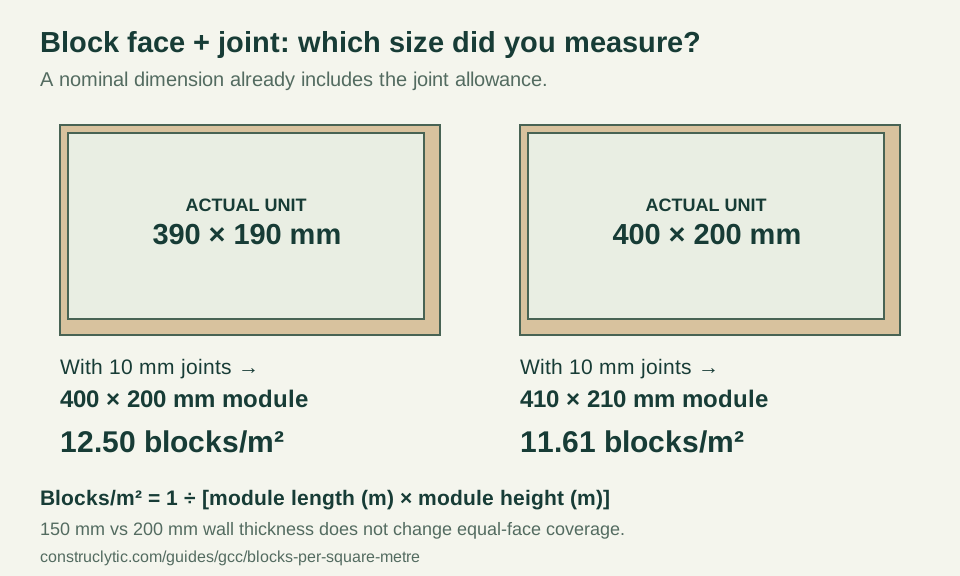
Nominal face size and actual face size
Think of the nominal face as one repeating wall module. A 390 × 190 mm actual unit laid with 10 mm joints occupies a 400 × 200 mm module. Its module area is 0.08 m², so one square metre contains 12.5 modules before openings and cutting.
If a supplier instead confirms that 400 × 200 mm is the actual unit face, a 10 mm joint makes the repeating module 410 × 210 mm. That is 0.0861 m² and approximately 11.6144 units/m². Never add a joint to a dimension already described as nominal.
| Supplier dimension | Face used in calculation | Blocks per m² |
|---|---|---|
| Nominal 400 × 200 mm | 0.400 × 0.200 m | 12.5000 |
| Actual 390 × 190 mm + 10 mm joint | 0.400 × 0.200 m | 12.5000 |
| Actual 400 × 200 mm + 10 mm joint | 0.410 × 0.210 m | 11.6144 |
Worked example: 30 m boundary wall
For a 30 × 2.4 m wall, gross area is 72 m². With no openings and a nominal 400 × 200 mm face, net quantity is 72 ÷ 0.08 = 900 blocks. An illustrative 5% cutting and breakage allowance gives 945 blocks.
Now include a 3 × 2.4 m gate opening. Deduct 7.2 m² to leave 64.8 m². The unadjusted count is 810; multiplying by 1.05 gives 850.5, so round the final purchase count up to 851 blocks. Do not round 850.5 down or round every intermediate wall fraction separately.
If the unit is actually 400 × 200 mm plus joints, the no-opening calculation is 72 ÷ 0.0861 × 1.05 = 878.05, rounded to 879 units. This large difference is why the dimension convention must be confirmed first.
150 mm versus 200 mm thickness
Two units with the same length and height but different thickness have the same face coverage. Thickness does affect material weight, mortar bedding, grout quantity, thermal or acoustic performance and structural use. Hollow and solid units also differ in these respects.
The wall designer specifies the unit type, strength, thickness, reinforcement, movement joints, restraint and foundations. A taller boundary wall exposed to wind is not made safe just by choosing a 200 mm block. The calculator is a count from a selected design, not a thickness selector.
Mortar and cement bags cannot come from face area alone
Mortar demand depends on the unit's bedding surfaces, joint thickness and how the wall is laid. Hollow blocks may use face-shell bedding, so treating the entire wall thickness as solid mortar exaggerates consumption. Use the specified mortar product's confirmed units-per-bag yield or a measured trial panel.
For site-mixed mortar, get the approved mix and measured yield. Cement bags require that yield and the actual cement bag mass; a universal 'bags per m²' figure would hide several assumptions. Count lintels, special corner blocks, reinforcement, grout and plaster as separate lines.
Before placing the block order
Check the bond pattern, wall returns, pilasters, gate supports and special units against the drawing. Deduct only the openings that truly interrupt blockwork. Add reveals or returns as their own measurements instead of restoring the opening through a waste percentage.
Ask how blocks are packed and sold. If the supplier sells only full pallets, round the calculated count to that package after applying your allowance. Keep both the calculated units and purchase units on the quote so leftover stock is visible.
Questions people ask
Does a 200 mm block wall need more blocks than a 150 mm wall?
Not if their nominal face length and height match. Wall thickness changes other quantities and design requirements, but not the face count.
Which dimensions go into the calculator?
Enter nominal module dimensions including the joint: 400 and 200 mm for a 390 × 190 mm unit with 10 mm joints, or 410 and 210 mm for an actual 400 × 200 mm unit with those joints.
Is the allowance always 5%?
No. It is an example input. Confirm an allowance for your cutting layout, special units, handling and supplier package.
Sources and calculation basis
Source links support the specific technical points below. Worked quantities are Construclytic calculations using the assumptions shown above. References do not establish local prices or replace the project specification.
- CMHA: concrete masonry shapes and sizesExplains actual and nominal dimensions; nominal dimensions include a mortar-joint allowance.