Quick answer
A 6 × 10 m driveway has 60 m² of plan area. If the installed paver module is 200 × 100 mm, coverage is 50 pieces/m²: 3,000 pieces net, or 3,150 with an illustrative 5% allowance. Confirm the manufacturer's actual installed coverage.
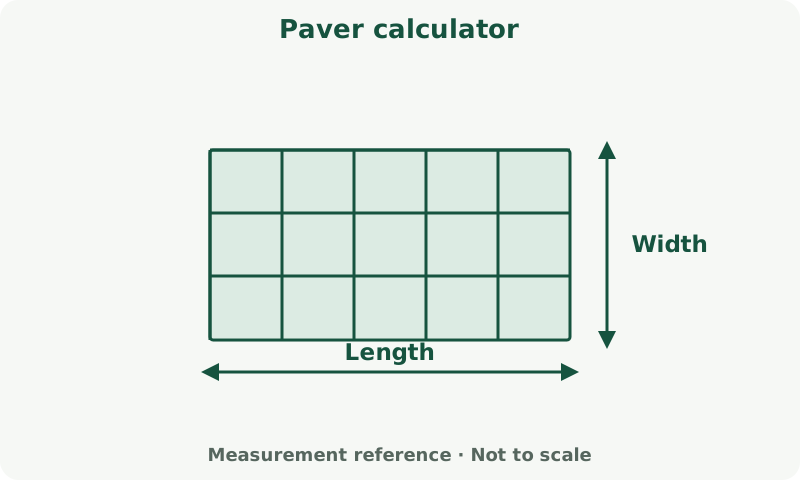
Pieces per square metre
For a rectangular installed module, pieces per m² = 1 ÷ (module length in metres × module width in metres). A 200 × 100 mm module gives 50; 200 × 200 mm gives 25; and 300 × 300 mm gives about 11.11. Use the laid module or manufacturer's published coverage, not an assumed joint width added twice.
Some interlock patterns use multiple shapes or sizes in a fixed pack. In that case, order by the pack's coverage and the manufacturer's laying pattern. A single-unit formula will not preserve the correct mix of shapes.
| Installed module | Pieces / m² | 60 m² net count |
|---|---|---|
| 200 × 100 mm | 50 | 3,000 |
| 200 × 200 mm | 25 | 1,500 |
| 300 × 300 mm | 11.111… | 666.667 before final rounding |
Worked example: pavers and kerbs
For 60 m² at 50 pieces/m², net pavers are 3,000. A 5% example allowance gives 3,150; an 8% scenario gives 3,240. Neither percentage is a manufacturer requirement. Mark the actual perimeter cuts and pattern on a layout before choosing the allowance.
A 6 × 10 m rectangle has 32 m of perimeter. If the 6 m vehicle entrance uses a separate flush threshold detail, the remaining perimeter is 26 m. Do not automatically deduct it if it also needs a restraint. For 0.5 m kerb units, 26 ÷ 0.5 gives 52 units before cutting, corners and the actual joint layout.
Base and bedding are separate volumes
If the project design specifies 150 mm compacted base, its in-place volume under 60 m² is 9 m³. If it separately specifies 25 mm bedding, that layer is 1.5 m³. These dimensions are a worked arithmetic example, not a recommended section for every driveway.
Loose-delivered volume or tonnes require an appropriate supplier density and compaction basis. Do not order nine loose cubic metres simply because the compacted base volume is nine cubic metres. Confirm the pavement section, soil suitability, drainage, falls and vehicle loading with the responsible designer or installer.
Pattern, edging and drainage
A herringbone pattern and a stretcher pattern create different boundary cuts; the orientation and driveway shape matter as much as the pattern name. Border courses, colour changes, channels, covers and curves require a separate count or marked cutting plan.
Resolve levels at the gate, garage threshold, building and drains before ordering. Extra bedding is not an appropriate way to disguise a badly prepared base. Surface water must have the designed drainage route, and edge restraints must match the paving system.
A comparable interlock quote
Ask suppliers and installers to distinguish pavers, excavation, disposal, base, bedding, jointing sand, kerbs, drainage and labour. Record unit thickness, finish, colour, pack coverage, delivery charge and breakage policy. A QAR/m² number for supply only is not comparable with an installed price.
The cost model is purchased paver quantity × current unit rate, plus the separately measured layers and works. This guide publishes no unsourced Qatar price range. Enter your own dated offers and keep a spare-stock line if you want matching units for later repairs.
Questions people ask
Is 5% waste enough for herringbone?
There is no universal percentage. Use the actual pattern, orientation and cut layout; compare explicit scenarios while the layout is unresolved.
Can I use patio pavers for a driveway?
Confirm the product and complete pavement system are specified for the vehicle loading and site. Face coverage alone says nothing about suitability.
Should the supplier sell by pieces or m²?
Either can work when the coverage basis is stated. Convert to whole packs at the end and verify the quoted installed-module coverage.
Sources and calculation basis
Source links support the specific technical points below. Worked quantities are Construclytic calculations using the assumptions shown above. References do not establish local prices or replace the project specification.
- CMHA: construction of interlocking concrete pavementsInstallation sequence and separate subgrade, base, bedding, edge and paver layers.