On this page
Quick answerBank volume is the enlarged plan times the depthWorked example: a 12 × 10 m footprintA raft, a strip and a set of pads are different holesLoose soil swells, and the published factors do not agreeBackfill is the space that remains, then a shrinkage factorTruck loads divide the loose volume by a body you replaceFour example footprints, one factor, one truckThe order is a volume, not a price and not a shoring planQuick answer
Bank volume = (footprint length + working space on both sides) × (footprint width + working space on both sides) × depth. A 12 × 10 m example footprint, with 0.50 m of working space on each side and a depth of 0.80 m, is (12 + 1.00) × (10 + 1.00) × 0.80 = 114.4 m³ in the ground. For loam in Table 1-1 of Army TM 3-34.62, loose volume is 114.4 × 1.25 = 143 m³, which is 12 loads in an assumed 12 m³ body. The working-space collar, if it is the only soil put back, is 18.4 m³ compacted.
Bank volume is the enlarged plan times the depth
Bank m³ = (length + 2 × working space) × (width + 2 × working space) × depth, with every dimension in metres. Length and width are the building footprint. Working space is the extra excavation beyond that footprint on each side, so both sides add twice the stated distance. Depth is the excavated depth, not the thickness of the concrete that will sit in the hole. The 12 m, 10 m, 0.50 m and 0.80 m below are example dimensions for one arithmetic pass. They are not a surveyed villa, a market average, or a foundation design.
This rectangle is a raft-style dig: the whole footprint comes out. Isolated pads and a strip footing do not. Their volumes are the pads, or the trench, not the footprint times a depth. Sloping sides, steps in the formation and a basement that is only under part of the plan are extra shapes. Add those shapes. Do not hide them inside the working space.
Worked example: a 12 × 10 m footprint
The example footprint is 12 × 10 = 120 m². Working space of 0.50 m on each side makes the excavated plan (12 + 1.00) × (10 + 1.00) = 13 × 11 = 143 m². At a depth of 0.80 m the bank volume is 143 × 0.80 = 114.4 m³. That is the soil in the ground, before it is dug and before anything is put back.
The same outline as a strip, or as eight pads, is calculated later and is smaller. 114.4 m³ is only this full-plan dig. A deeper formation, a smaller working space, or a footprint that is not 12 × 10 m changes the product. Replace the four inputs. Do not scale 114.4 m³ by a floor count or by a built-up area.
| Line | Calculation | Quantity |
|---|---|---|
| Footprint | 12 × 10 | 120 m² |
| Excavated plan | (12 + 1.00) × (10 + 1.00) | 143 m² |
| Bank volume | 143 × 0.80 | 114.4 m³ |
A raft, a strip and a set of pads are different holes
A closed rectangular strip can be measured on its centreline. For this example the centreline is the 12 × 10 m outline, so the centreline length is 2 × (12 + 10) = 44 m. An example footing 0.60 m wide, with 0.30 m of working space on each side, is an excavated width of 1.20 m. For a constant-width closed rectangle, centreline length × width equals the ring area: the corner overlaps cancel. Check: (12 + 1.20) × (10 + 1.20) − (12 − 1.20) × (10 − 1.20) = 13.2 × 11.2 − 10.8 × 8.8 = 147.84 − 95.04 = 52.8 m². At 1.00 m depth the bank volume is 52.8 m³, and 52.8 × 1.25 = 66 m³ loose. Open the trench calculator with the factor left at 0. Depth on that tool is millimetres. Its truck field stays in cubic yards even in metric mode, so do not read its load count as the 6 loads below.
Eight example pads, each 1.20 × 1.20 m with 0.30 m of working space on each side, are eight holes of 1.80 × 1.80 m. One hole at 1.00 m depth is 3.24 m³. Eight are 25.92 m³ bank and 25.92 × 1.25 = 32.4 m³ loose. The same 12 × 10 m villa is 114.4 m³ as the raft dig, 52.8 m³ as the strip, and 25.92 m³ as the eight pads. Digging the whole footprint because the drawing shows pads multiplies the wrong shape. The concrete that stays in the strip, an example 0.60 × 0.40 m section along 44 m, is 44 × 0.60 × 0.40 = 10.56 m³. That concrete is not excavation. Measure it in the footing calculator, with depth in millimetres and waste at 0. The eight pads of concrete, each 1.20 × 1.20 × 0.40 m, are 4.608 m³.
| Shape | Bank m³ | Loose m³ | Loads at 12 m³ |
|---|---|---|---|
| Raft, 0.50 m working space, 0.80 m deep | 114.4 | 143 | 12 |
| Strip, excavated width 1.20 m, 1.00 m deep | 52.8 | 66 | 6 |
| Eight pads, 1.80 × 1.80 m each, 1.00 m deep | 25.92 | 32.4 | 3 |
Loose soil swells, and the published factors do not agree
Loose m³ = bank m³ × the loose-from-bank factor for the soil you actually have. TM 3-34.62, Earthmoving Operations, May 2025 with Change 1 of July 2026, Table 1-1, prints that factor for loam, which it calls common earth, as 1.25, and the compacted factor from the same bank cubic metre as 0.90. The worked 143 m³ is 114.4 × 1.25. Table 1-2 of the same manual prints wet earth, loam or silt, at 25 percent swell and a load factor of 0.80, which is the same 1.25 because 1 ÷ 1.25 = 0.80. Dry earth on Table 1-2 is not a point. It is a swell of 15 to 35 percent and a load factor of 0.74 to 0.87. Sand or gravel on Table 1-1 is 1.11 loose and 0.95 compacted. Table 1-2 prints sand and gravel, dry or wet, at 10 to 15 percent swell and a load factor of 0.87 to 0.91. Clay does not agree with itself: Table 1-1 prints 1.43 loose and a return factor of 0.70, while Table 1-2 and paragraph 1-11 print 40 percent swell, so 1 cubic yard in the bank fills 1.4 cubic yards loose, and a load factor of 0.72. Both clay readings stay. They are not averaged, and the worked example does not use either of them.
Caterpillar's loose-and-bank density table prints a load factor of 0.80 for earth, dry packed, beside loose 1,510 kg/m³ and bank 1,900 kg/m³. 1,510 ÷ 1,900 = 0.7947, which that cell rounds to 0.80, so the printed factor is loose density divided by bank density. That is bank volume divided by loose volume. Loose volume is then bank ÷ 0.80, which is bank × 1.25. The same page prints 0.81 for earth, loam (1,250 ÷ 1,540 = 0.8117), 0.80 for clay, wet (1,660 ÷ 2,080 = 0.7981), 0.89 for sand, dry loose (1,420 ÷ 1,600 = 0.8875) and 0.70 for topsoil (950 ÷ 1,370 = 0.6934). Swell percent is not a column on that page. 1 ÷ 0.89 − 1 = 0.1236, and 1 ÷ 0.81 − 1 = 0.2346, are calculations from the printed load factors, not second printed swells. Caterpillar's swell page says a 30 percent swell means the loose volume is 1.3 times the bank volume. Its prose then calls the load factor the ratio of loose volume to bank volume, while the third column of the table on that page is 0.800 at 25 percent swell, and 1 ÷ 1.25 = 0.800. The prose and the column do not name the same ratio. This guide follows the density-table arithmetic and the Army 1.25. It does not follow the prose sentence.
| Source and material | Loose m³ | Compacted m³ |
|---|---|---|
| TM 3-34.62 Table 1-1, sand or gravel | 1.11 | 0.95 |
| TM 3-34.62 Table 1-1, loam (common earth) | 1.25 | 0.90 |
| TM 3-34.62 Table 1-1, clay | 1.43 | 0.90 |
| TM 3-34.62 Table 1-2, clay, dry or wet | 1.40 | — |
| TM 3-34.62 Table 1-2, earth, dry | 1.15–1.35 | — |
| TM 3-34.62 Table 1-2, earth, wet | 1.25 | — |
| TM 3-34.62 Table 1-2, sand or gravel | 1.10–1.15 | — |
| Caterpillar, earth, dry packed, load factor 0.80 | 1.25 | — |
| Caterpillar, sand, dry loose, load factor 0.89 | 1.1236 | — |
| FHWA Exhibit 5.1 A, earth loam, dry, loose swell 50% | 1.50 | — |
Backfill is the space that remains, then a shrinkage factor
Compacted backfill is the hole that is still empty after the concrete, blinding and anything else that stays in the ground. It is not the excavation. For the example raft, the footprint is 120 m² and the excavated plan is 143 m², so the collar is 23 m². If that collar is the only soil put back, and it is filled for the full 0.80 m, the compacted volume is 23 × 0.80 = 18.4 m³. That sentence assumes the structure fills the 12 × 10 m footprint through the whole depth. If the concrete is shallower, add the empty volume above it. The footprint table later does not add that volume.
TM 3-34.62 Table 1-1 says 1 bank cubic metre of loam becomes 0.90 cubic metres compacted, so the bank quantity that compacts into 18.4 m³ is 18.4 ÷ 0.90 = 20.4444… m³. Hauled loose, that bank is 20.4444… × 1.25 = 25.5555… m³, written 25.5556 when it is rounded half up to 4 decimal places. FHWA's earthwork page, updated 15 January 2026, prints a different set. Its illustration says 1 m³ in the cut may use 1.25 m³ in the truck and 0.65 to 0.85 m³ in the embankment. For moderate soil it says the shrink is ten to 25 percent. For light soil, and for fills on swampy ground, it says 20 to 40 percent or greater. For heavy soil with deep cuts it says about 15 percent shrink to 5 percent swell. Exhibit 5.1 A prints earth loam, dry, at 50 percent loose swell and an embankment figure of −12, and the footnote says a negative number is a shrinkage. Read from the in-situ cubic metre, −12 is 0.88 m³ compacted, which is not the ten-to-25-percent sentence and not 0.90. The same exhibit prints in-situ 3,030 lb/yd³ and loose 2,070 lb/yd³ for that dry loam, and 3,030 ÷ 2,070 − 1 = 0.4638, which is not the printed 50 percent. The printed percent and the printed densities are both shown. A test on the plot replaces every one of these rows. The manual says the same: weights and load factors vary with grain size, moisture and compaction.
Truck loads divide the loose volume by a body you replace
Loads = the loose volume divided by the usable body, rounded up to a whole load. The 143 m³ of loose loam from the example raft, divided by an assumed 12 m³, is 11.9166…, which rounds up to 12 loads. The same 143 m³ is 15 loads at 10 m³, 10 loads at 15 m³ and 8 loads at 20 m³. Those four capacities are assumptions in a band a reader might type. They are not a measured fleet, a Gulf tipper survey, or a legal payload. Replace 12 with the usable cubic metres your hauler states for this soil. A body that fills before it reaches the weight limit is a smaller number than the water-level volume of the box.
Use the loose volume against a loose body, or the bank volume against a bank body. Do not divide 114.4 m³ of bank soil by a loose body and call the result a load count. The dump-truck calculator divides the volume you type by the capacity you type, in the same unit, and its load-factor field is a second multiplier. Leave that field at 0 when 143 m³ is already the loose quantity. Putting 25 in that field would swell the soil a second time. The import for the 18.4 m³ collar, 25.5556 m³ loose, is ceil(25.5556 ÷ 12) = 3 loads at the same assumed body. Suitability of the dug soil for that backfill is not decided here. If it cannot go back, the export is the 12 loads and the import is a separate 3.
| Assumed body | 143 ÷ body | Loads |
|---|---|---|
| 10 m³ | 14.3 | 15 |
| 12 m³ | 11.9166… | 12 |
| 15 m³ | 9.5333… | 10 |
| 20 m³ | 7.15 | 8 |
Four example footprints, one factor, one truck
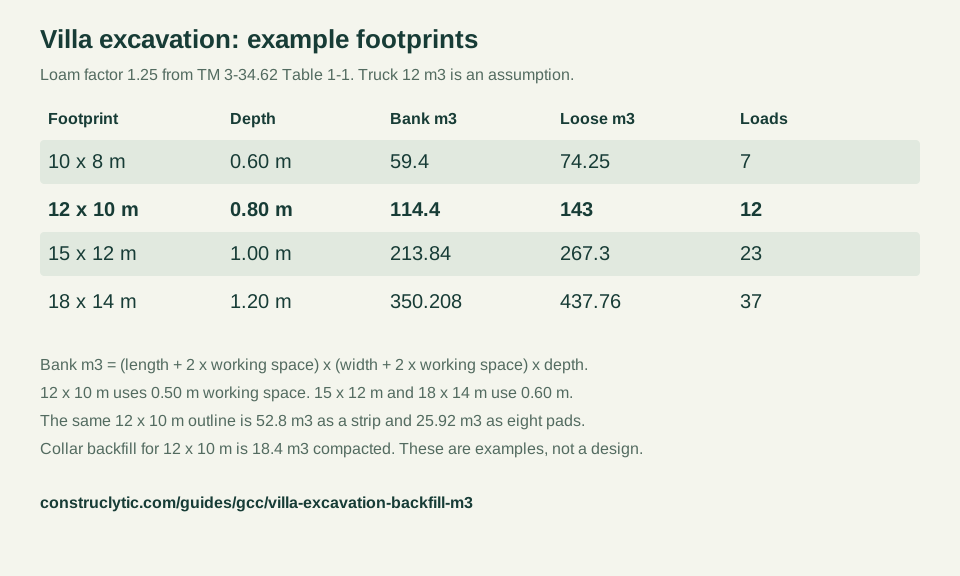
Each row is a full-plan dig: bank m³ = (length + 2 × working space) × (width + 2 × working space) × depth. Loose m³ = bank × 1.25, the Table 1-1 loam factor, not a blend with the FHWA 50 percent or the clay rows. Export loads are that loose volume divided by 12 m³, rounded up. The collar is the excavated plan minus the footprint, times the depth, and it is only the working space. Loose import is that collar divided by 0.90, then multiplied by 1.25. Recurring divisions are rounded half up to 4 decimal places, so 18.4 ÷ 0.90 × 1.25 is written 25.5556. Change the truck and the load columns change. The cubic metres do not.
A 10 × 8 m footprint with 0.50 m working space is an 11 × 9 m plan. At 0.60 m deep that is 59.4 m³ bank and 74.25 m³ loose, 7 export loads. A 15 × 12 m footprint with 0.60 m working space is 16.2 × 13.2 = 213.84 m². At 1.00 m deep that is 213.84 m³ bank and 267.3 m³ loose, 23 export loads. An 18 × 14 m footprint with 0.60 m working space at 1.20 m deep is 350.208 m³ bank and 437.76 m³ loose, 37 export loads. None of these footprints is a typical villa for a country. They are four arithmetic examples.
| Footprint | Working space | Depth | Bank m³ | Loose m³ | Export loads | Collar m³ | Loose import m³ | Import loads |
|---|---|---|---|---|---|---|---|---|
| 10 × 8 m | 0.50 m | 0.60 m | 59.4 | 74.25 | 7 | 11.4 | 15.8333 | 2 |
| 12 × 10 m | 0.50 m | 0.80 m | 114.4 | 143 | 12 | 18.4 | 25.5556 | 3 |
| 15 × 12 m | 0.60 m | 1.00 m | 213.84 | 267.3 | 23 | 33.84 | 47 | 4 |
| 18 × 14 m | 0.60 m | 1.20 m | 350.208 | 437.76 | 37 | 47.808 | 66.4 | 6 |
The order is a volume, not a price and not a shoring plan
No price is stated. Haul, disposal, the borrow pit and the compaction test are separate from the cubic metres. The concrete in the hole is a different quantity: the 5 m³ footing model is in cement, sand and aggregate for 1 m³, and reinforcement by element is in rebar kilograms per cubic metre. A pipe trench, with bank and loose kept apart, is in trench excavation volume. Load counts for a stated body are in dump truck loads. The other quantity pages are on the GCC construction guides.
This page does not choose a side slope, a support system, a safe depth or a clearance from a buried service. It does not say the dug soil may go back under a floor or a footing. FM 5-434 (2000) prints the same Table 1-1 factors as TM 3-34.62. Caterpillar says tests must be made to determine the material. FHWA says the project geotechnical unit assigns the shrink and swell, and that the exhibit is for estimating before that assignment. Use the row that names your soil, or a test, and keep the truck capacity as the number the hauler writes down.
Questions people ask
How do you calculate villa foundation excavation in m³?
Bank m³ = (length + 2 × working space) × (width + 2 × working space) × depth. A 12 × 10 m example footprint with 0.50 m working space on each side and a depth of 0.80 m is 13 × 11 × 0.80 = 114.4 m³. That is a full-plan dig. A strip or a set of pads on the same outline is a smaller volume.
What is the swell factor for excavated soil?
TM 3-34.62 Table 1-1 prints 1.11 for sand or gravel, 1.25 for loam and 1.43 for clay, as loose volume from one bank cubic metre. Table 1-2 prints clay at 40 percent, dry earth at 15 to 35 percent, wet earth at 25 percent, and sand or gravel at 10 to 15 percent. Caterpillar prints a load factor of 0.80 for earth, dry packed, which is a loose volume of 1.25 if that factor is bank divided by loose. FHWA Exhibit 5.1 A prints 50 percent loose swell for dry earth loam. The worked example uses 1.25 and does not average these.
How much does backfill shrink when it is compacted?
TM 3-34.62 Table 1-1 prints 0.95 compacted cubic metres from one bank cubic metre of sand or gravel, and 0.90 for loam and for clay. The example collar of 18.4 m³ therefore needs 18.4 ÷ 0.90 = 20.4444… bank cubic metres of loam. FHWA prints other shrinkage ranges, including ten to 25 percent for moderate soil and an embankment figure of −12 for dry earth loam. Those are not substituted for 0.90.
How many truck loads does a villa excavation take?
Divide the loose volume by the hauler's usable body and round up. The example 143 m³ is 12 loads at an assumed 12 m³, 15 loads at 10 m³, 10 loads at 15 m³ and 8 loads at 20 m³. Those bodies are assumptions. The 12 × 10 m strip example is 66 m³ loose, which is 6 loads at the same 12 m³.
Is a raft excavation the same volume as strip footings?
No. On the 12 × 10 m example, the raft dig is 114.4 m³ bank, the strip at 1.20 m excavated width and 1.00 m depth is 52.8 m³, and eight 1.80 × 1.80 m pads at 1.00 m depth are 25.92 m³. Use the shape on the drawing.
Sources and calculation basis
Source links support the points named beside them. Worked quantities are Construclytic calculations using the assumptions shown above. A price in a table is the figure that source printed on the date it was read. It is not a quotation for your site, and it does not replace the project specification.
- US Army TM 3-34.62: Earthmoving Operations, Table 1-1 and Table 1-2Opened 1 November 2026. TM 3-34.62/MCRP 3-40D.9, May 2025, incorporating Change 1, July 2026. Approved for public release. Table 1-1, from one bank cubic metre: sand or gravel 1.11 loose and 0.95 compacted; loam (common earth) 1.25 loose and 0.90 compacted; clay 1.43 loose and 0.90 compacted. The loose-to-bank factors are 0.90, 0.80 and 0.70. Table 1-2 swell and load factor: clay, dry or wet, 40 percent and 0.72; earth (loam or silt), dry, 15 to 35 percent and 0.74 to 0.87; earth, wet, 25 percent and 0.80; sand and gravel, dry or wet, 10 to 15 percent and 0.87 to 0.91. Paragraph 1-11 says 1 cubic yard of dry clay in the bank fills 1.4 cubic yards loose. The note says the numbers are averages and that a test is required for an exact weight. The worked example uses the loam row of Table 1-1 only.
- US Army FM 5-434: Earthmoving Operations, 2000, Table 1-1Opened 1 November 2026. FM 5-434, the 2000 field manual, prints the same Table 1-1 conversion factors: sand or gravel 1.11 and 0.95, loam 1.25 and 0.90, clay 1.43 and 0.90. The figure beside paragraph 1-7 shows 1 cubic yard in the bank, 1.25 cubic yards loose and 0.9 cubic yards compacted. TM 3-34.62 is the current manual. This PDF is cited because it is the public copy of the earlier table, not because it replaces the 2025 manual.
- Caterpillar: material density tables for earthwork volumesOpened 1 November 2026. Defines bank, loose and compact cubic measures. Loose-and-bank table, load factor printed beside the densities: earth, dry packed, loose 1,510 kg/m³, bank 1,900 kg/m³, load factor 0.80; earth, loam, 1,250 and 1,540, load factor 0.81; clay, wet, 1,660 and 2,080, load factor 0.80; sand, dry loose, 1,420 and 1,600, load factor 0.89; topsoil, 950 and 1,370, load factor 0.70. 1,510 ÷ 1,900 = 0.7947. The page says weight varies with moisture, grain size and compaction, and that tests must be made. It does not print a swell percent or a compacted factor for the earth, dry packed, row.
- Caterpillar: swell, void percentage and load factorsOpened 1 November 2026. Swell is the percentage of original volume added when bank material becomes loose. The worked sentence says a 30 percent swell means the loose volume is 1.3 times the bank volume. The prose calls the load factor the ratio of loose volume to bank volume. The table's third column at 25 percent swell is 0.800, and 1 ÷ 1.25 = 0.800. The second column at 25 percent is 20.0, which is 25 ÷ 125. This page is not used to override the density-table arithmetic or the Army 1.25.
- FHWA: earthwork design, shrink and swell factorsOpened 1 November 2026. Page last updated 15 January 2026. The illustration says 1 m³ in the cut may use 1.25 m³ in the transporting vehicle and 0.65 to 0.85 m³ in the embankment. Light soil, and fill on swampy ground, shrink 20 to 40 percent or greater. Moderate soil shrinks ten to 25 percent. Heavy soil with deep cuts is about 15 percent shrink to 5 percent swell. Exhibit 5.1 A prints earth loam, dry, at 50 percent loose swell and embankment −12; damp at 43 and −4; wet mud at 0 and −20. Sand, dry, is 11 and −11. The footnote says a negative number is a shrinkage, factors are subject to ±33 percent variation, and in-situ density is subject to ±5 percent. For dry earth loam the printed densities are 3,030 lb/yd³ in situ and 2,070 lb/yd³ loose, and 3,030 ÷ 2,070 − 1 = 0.4638, which is not 50 percent. The exhibit is for estimating before the geotechnical assignment. It is not averaged with Table 1-1.