Quick answer
At 4 in, a 12 × 12 ft patio needs 48 ft³ = 1.7778 yd³ before loss. With an illustrative 10% allowance, use 52.8 ft³ = 1.9556 yd³: 88 bags at 0.60 ft³ each or 118 bags at 0.45 ft³ each. Confirm the selected product yield.
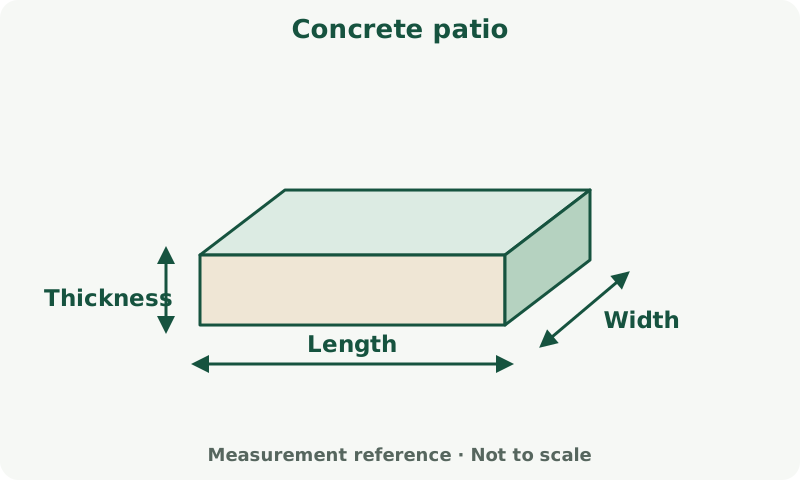
Convert inches before multiplying
The plan area is 12 × 12 = 144 ft². Four inches is 4 ÷ 12 = one-third of a foot. Net volume is 144 × 1/3 = 48 ft³. Divide by 27 for 1.7778 cubic yards. Six inches is half a foot, giving 72 ft³ or 2.6667 yd³.
The same 12 ft dimension is 3.6576 m and 4 in is 101.6 mm. Metric volume is 3.6576² × 0.1016 = 1.3592 m³ before loss. This is the same pour as 1.7778 yd³; it is not a separate sizing rule.
| Thickness | Net yd³ | With 10% yd³ | 80 lb bags at 0.60 ft³ | 60 lb bags at 0.45 ft³ |
|---|---|---|---|---|
| 4 in | 1.7778 | 1.9556 | 88 | 118 |
| 6 in | 2.6667 | 2.9333 | 132 | 176 |
Bags are calculated from volume, then rounded
For the 4 in case, 48 × 1.10 = 52.8 ft³. Dividing by 0.60 gives exactly 88 bags. Dividing by 0.45 gives 117.333…, so buy 118 whole bags. Those yields are approximate figures for the cited QUIKRETE Concrete Mix product, not universal values for all 60 lb and 80 lb products.
For a truck order, apply the supplier's increment to the 1.9556 yd³ allowance quantity. If that supplier uses quarter-yard increments, the order becomes 2 yd³. Confirm minimum loads, top-up rules and any short-load fee before comparing the truck price with bag costs.
Edges, steps and slope need explicit geometry
The basic answer describes a uniform slab only. For a thickened edge, add just the extra depth below the main slab over the edge strip area; adding the entire beam depth would double-count concrete already included. Steps, footings and adjoining pads are separate shapes.
A constant-thickness slab laid on a matching sloped base differs from one poured over a level base to a sloping top. For the latter, use the measured average thickness where the geometry permits it or split into sections. Do not make drainage or thickness decisions by increasing waste.
Nearby patio sizes at 4 in
Use the same formula for other rectangles. The table below holds depth at 4 in and the example allowance at 10%. Purchase increments and bag rounding are applied after these unrounded volumes.
Measure the inside of the actual forms. Small depth differences across the whole footprint can use more concrete than the neat drawing suggests. Resolve the subgrade and thickness before placing the order.
| Plan size | Net yd³ | With 10% yd³ |
|---|---|---|
| 10 × 10 ft | 1.2346 | 1.3580 |
| 12 × 12 ft | 1.7778 | 1.9556 |
| 12 × 16 ft | 2.3704 | 2.6074 |
| 16 × 16 ft | 3.1605 | 3.4765 |
Compare the complete job cost
Use a dated material quote, then separate reinforcement, base, forms, labour, delivery, finishing, curing and disposal. Mixing dozens of bags also requires a workable placement schedule and equipment. A low bag price alone does not establish the cheaper finished job.
Keep the mix specification, reinforcement and curing requirements with the quantity takeoff. The calculator measures materials from those decisions; it does not select them.
Questions people ask
Will 2 yards cover a 12 × 12 patio?
For a uniform 4 in slab, 2 yd³ exceeds the 1.9556 yd³ example quantity with 10% allowance. It does not cover unspecified thickened edges, footings or deeper areas.
Can I use cement bags instead of concrete-mix bags?
No. The bag counts use complete concrete mix with a stated yield. Cement alone is only one constituent.
How many bags for a 6 in patio?
The example with 10% allowance is 79.2 ft³: 132 bags at 0.60 ft³ or 176 bags at 0.45 ft³, subject to the selected product's yield.
Sources and calculation basis
Source links support the specific technical points below. Worked quantities are Construclytic calculations using the assumptions shown above. References do not establish local prices or replace the project specification.
- QUIKRETE Concrete Mix No. 1101 product dataProduct-specific approximate yields: 60 lb = 0.45 ft³; 80 lb = 0.60 ft³. Check your actual bag.
- NRMCA: ordering and hot-weather concrete resourcesTechnical background: CIP 31 covers ordering, CIP 12 hot-weather placement. This is not a Qatar price source.