On this page
Quick answerPrices checked on 24 October 2026Blocks per square metre, from the face and the jointQAR per square metre of a 200 mm wallWorked example: a 30 m by 3 m villa wallThermal conductivity, and what that does not say about the billWeight, fire, cutting and the first courseQuick answer
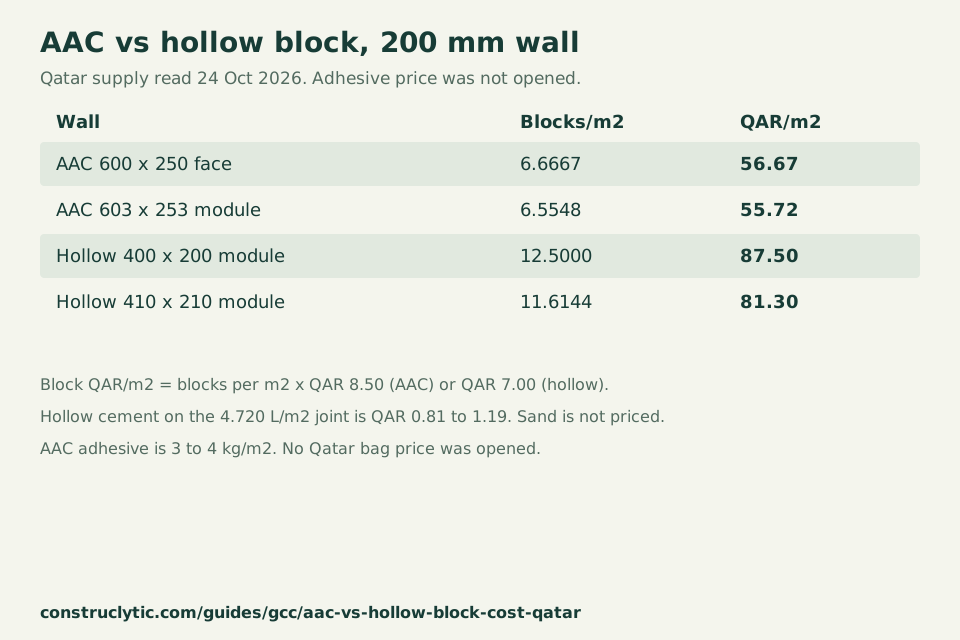
As of 24 October 2026, published sources put a 200 mm wall at QAR 55.72–56.67 per m² in AAC blocks (600 × 250 mm face, QAR 8.50 each) plus 3–4 kg/m² of thin-bed adhesive with no Qatar price opened, and QAR 81.30–87.50 per m² in concrete hollow blocks (400 × 200 mm face, QAR 7.00 each) plus QAR 0.81–1.19 per m² of face-shell cement. QAR/m² of blocks = (1 ÷ module area in m²) × price per block.
Prices checked on 24 October 2026
GCCPricing lists an autoclaved aerated block, 600 × 250 × 200 mm, at QAR 8.50 each for Qatar. The row is supply only, an indicative distributor rate, last updated 15 October 2026. The manufacturer field says Ytong/Siporex. That is the label on the price page, not an invoice from a named Doha yard. The same reading lists a local concrete hollow block, 400 × 200 × 200 mm, at QAR 7.00 each, also supply only and last updated 15 October 2026. No second Qatar unit price for either block was opened, so the ranges below come from the face-size readings, not from two merchants.
Ordinary Portland cement, printed as 43 grade to IS 8112 in a 50 kg bag, is QAR 28.50 per bag on GCCPricing, supply only, last updated 15 October 2026. The grade label is what that page prints. Washed fine sand is QAR 85.00 per tonne on the current table, last updated 15 October 2026, while the history table on the same page stays at QAR 28.50 through 30 September 2026. The page also prints no loose bulk density, so the sand line stays in litres and is not turned into riyals. No Qatar price for AAC thin-bed adhesive was opened. ASLAN states 3–4 kg/m² and a 25 kg bag. DCP Cemfix AAC, sold in Qatar in 25 kg bags, prints a yield of about 17.3 litres and no riyal rate. The other quantity guides are on the GCC construction guides. Dirham block prices are in concrete block price in the UAE. Saudi riyal block prices are in concrete block price in Saudi Arabia.
Blocks per square metre, from the face and the joint
Blocks per m² = 1 ÷ (module length in metres × module height in metres). ASLAN’s block face is 600 × 250 mm, so 0.600 × 0.250 = 0.150 m² and 1 ÷ 0.150 = 6.666… blocks per m². Their calculator calls that about 6.67. Their coverage table prints 6.66 for a 200 mm block of that face. Both are the same face with the joint left out. The block specification and the installation note lay the units on a 3 mm thin-bed joint, so the module is 603 × 253 mm. That is 0.603 × 0.253 = 0.152559 m², and 1 ÷ 0.152559 = 6.5548 blocks per m². The adhesive sheet also allows an applied thickness of 3–6 mm. A 5 mm joint would be a different module, and it is not the count used below.
A hollow block written as 400 × 200 mm is the same fork as blocks per square metre. If 400 × 200 mm already includes the 10 mm joint, the module is 0.400 × 0.200 = 0.080 m² and the wall holds 12.5 blocks per m². If 400 × 200 mm is the actual face, the module is 410 × 210 mm, 0.0861 m², and 1 ÷ 0.0861 = 11.6144 blocks per m². Thickness does not change either count. AAC uses the thin-bed adhesive. The hollow block uses sand-cement mortar, and the litres are in mortar for a block wall per square metre.
| Reading | Module | Blocks per m² |
|---|---|---|
| AAC face, joint not included | 600 × 250 mm | 6.6667 |
| AAC with a 3 mm joint | 603 × 253 mm | 6.5548 |
| Hollow, 400 × 200 mm module | 400 × 200 mm | 12.5000 |
| Hollow, actual 400 × 200 mm plus 10 mm | 410 × 210 mm | 11.6144 |
QAR per square metre of a 200 mm wall
Block supply per m² is the block price times the blocks per m². At QAR 8.50, the AAC face with no joint is 8.50 ÷ 0.150 = QAR 56.67 per m². The 3 mm module is 8.50 ÷ 0.152559 = QAR 55.72 per m². At QAR 7.00, the hollow 400 × 200 mm module is 12.5 × 7.00 = QAR 87.50 per m², and the actual-face reading is 7.00 ÷ 0.0861 = QAR 81.30 per m². Each piece of AAC costs more than each hollow block. The square metre costs less because the face is larger. That comparison is supply of blocks only.
The hollow 200 mm row in the mortar guide is 4.720 litres per m² before waste, for face-shell bedding on a 400 × 200 mm module. One 10% allowance and a dry factor of 1.33 give 4.720 × 1.10 × 1.33 = 6.905 litres of dry material per m². Split 1:4, 1:5 and 1:6, then price the cement at QAR 28.50 ÷ 50 kg = QAR 0.57 per kg, at both 1,440 and 1,506 kg/m³. The cement line is QAR 0.81 to QAR 1.19 per m². Sand is 5.524 to 5.919 litres and stays unpriced. AAC adhesive stays at 3–4 kg/m², which is 0.12–0.16 of a 25 kg bag, with the riyal cell blank. The first course is a separate cement-sand bed on the ASLAN pages, and those pages do not print its kilograms.
| Mix | kg at 1,440 | QAR at 1,440 | kg at 1,506 | QAR at 1,506 | Sand litres |
|---|---|---|---|---|---|
| 1:4 | 1.989 | 1.134 | 2.080 | 1.186 | 5.524 |
| 1:5 | 1.657 | 0.945 | 1.733 | 0.988 | 5.754 |
| 1:6 | 1.421 | 0.810 | 1.486 | 0.847 | 5.919 |
Worked example: a 30 m by 3 m villa wall
Gross area is 30 × 3 = 90 m², with no openings in this example. AAC with the joint left out is 90 ÷ 0.150 = 600 blocks, and 600 × 8.50 = QAR 5,100. The 3 mm module is 90 ÷ 0.152559 = 589.936, ordered as 590 blocks, and 590 × 8.50 = QAR 5,015. The hollow module is 90 ÷ 0.080 = 1,125 blocks, and 1,125 × 7.00 = QAR 7,875. The actual face is 90 ÷ 0.0861 = 1,045.296, ordered as 1,046 blocks, and 1,046 × 7.00 = QAR 7,322. Round the piece count once, at the end. Doors and windows come off the 90 m² before that rounding. The concrete block calculator opens on 30 m by 3 m with a 603 × 253 mm face and zero waste, which is the 590-block line.
Thin-bed adhesive at 3 kg/m² is 90 × 3 = 270 kg, or 10.8 bags of 25 kg, ordered as 11. At 4 kg/m² it is 360 kg, or 14.4 bags, ordered as 15. The bag price was not on a page that opened, so the order stops at bags. Hollow-block mortar on the module, with the same 10% and dry factor, is 90 × 6.90536 = 621.482 litres of dry material. At 1:4 that is 178.987 kg of cement at 1,440 kg/m³ and 187.190 kg at 1,506 kg/m³, both ordered as 4 bags of 50 kg, which is 4 × 28.50 = QAR 114. At 1:6 it is 127.848 kg and 133.707 kg, both ordered as 3 bags, which is QAR 85.50. Sand for that wall is not given a riyal total.
Thermal conductivity, and what that does not say about the bill
ASLAN’s grade G2 block declares thermal conductivity at 0.13 W/m·K maximum, and the cited Wimpey test is 0.1201 W/m·K. Grade G4 declares 0.16 W/m·K maximum. Dividing by the 0.200 m thickness is the material conductance only: 0.13 ÷ 0.200 = 0.65 W/m²K, 0.1201 ÷ 0.200 = 0.6005 W/m²K, and 0.16 ÷ 0.200 = 0.80 W/m²K. That division leaves out surface films and plaster. ASLAN’s calculator states a 200 mm wall U-value of 0.58 W/m²K and a 250 mm wall at 0.48 W/m²K, and it states a QCS 2014 wall limit of 0.57 W/m²K. This page did not open QCS 2014, so those three figures stay attributed to ASLAN. No hollow-block conductivity was opened from a current Qatar manufacturer.
A 1996 Qatar University study of one model house, using Carrier E20-II, put thermostone conductivity at 0.383 W/m°C for the shape in that paper and hollow-block conductivity at 1.443 or 0.960 W/m°C for the two shapes drawn there. It reported 25% to 30% less annual electrical energy for cooling with thermostone walls than with hollow-block walls, and 28% to 34% less electricity cost, under that study’s roofs and occupancy. The paper’s tariff was QR 0.06 per kWh for the first 4,000 kWh in a month and QR 0.08 above that. It did not publish a kilowatt-hour total that this page can copy onto a villa, and 0.383 is not the ASLAN lambda above. No current Kahramaa tariff page was opened, so this guide does not state a 2026 bill saving.
Weight, fire, cutting and the first course
Dry mass per square metre of solid AAC is the declared density times 0.200 m. Grade G2 is 500 ± 50 kg/m³, so 90 to 110 kg/m², and the cited test density of 502 kg/m³ is 100.4 kg/m². Grade G4 is 600 ± 50 kg/m³, so 110 to 130 kg/m². That is dry block material. It does not include the 3 mm adhesive. CMHA’s table for an 8 in (203 mm) single-wythe hollow wall, ungrouted, face-shell bedding, runs from 24 psf at 85 pcf concrete to 39 psf at 145 pcf. The same note prints 35 psf as 171 kg/m², so 24 × 171 ÷ 35 = 117 kg/m² and 39 × 171 ÷ 35 = 191 kg/m². That is a US assembly with 3/8 in joints and the mortar included. It is not a weighed Qatar 400 × 200 × 200 mm block. No Qatar hollow-block kilogram was opened.
ASLAN rates fire resistance of a 200 mm block wall at 4 hours minimum, and the cited test is greater than 240 minutes, to ACI 216.1. The compliance statement is dated 13 September 2026. No Qatar hollow-block fire-hour rating was opened, so none is stated. On the ASLAN installation note, the first course sits on a cement-sand bed, later courses use a 3 mm notched-trowel joint, tongue-and-groove perpends are laid dry, and the bond overlap is at least 100 mm. Units are cut with an AAC band saw or a hand saw. A service chase is limited to one-third of the wall thickness. Chipped edges are filled with AAC repair mortar before plaster. Plaster itself is a separate method statement in that profile, and no plaster rate is copied from it.
Questions people ask
Is thermostone cheaper than hollow block in Qatar?
As of 24 October 2026, the blocks for a 200 mm wall are QAR 55.72–56.67 per m² in AAC at QAR 8.50 each, and QAR 81.30–87.50 per m² in hollow block at QAR 7.00 each. Face-shell cement adds QAR 0.81–1.19 per m² on the hollow wall. No Qatar price for the AAC adhesive was opened, so the finished material total cannot be closed.
How many AAC blocks per m²?
A 600 × 250 mm face is 1 ÷ (0.600 × 0.250) = 6.666… blocks per m², which ASLAN calls about 6.67. With the 3 mm joint in their laying note, the module is 603 × 253 mm and the count is 6.5548 blocks per m². Thickness does not change the face count.
How many hollow blocks are in a square metre of 200 mm wall?
The 200 mm label is the thickness. A 400 × 200 mm module is 12.5 blocks per m². An actual 400 × 200 mm face plus 10 mm joints is 11.6144 blocks per m². Confirm which dimension the supplier means before you multiply by QAR 7.00.
Does thermostone lower the Kahramaa bill?
ASLAN’s declared conductivity is 0.13 or 0.16 W/m·K depending on grade, against a tested 0.1201 W/m·K for G2. A 1996 Qatar University model house used 25% to 30% less annual cooling electricity with the thermostone of that paper than with hollow block. That is not a kilowatt-hour figure for a current villa, and no 2026 Kahramaa tariff was opened.
What does AAC use instead of sand-cement mortar?
ASLAN lays the first course on a cement-sand bed and the courses above it with thin-bed adhesive at 3–4 kg/m², in a joint they state as 3 mm. A 25 kg bag is the pack. No Qatar riyal price for that bag was opened. Hollow-block joint litres and 50 kg cement bags are in the mortar guide.
Sources and calculation basis
Source links support the points named beside them. Worked quantities are Construclytic calculations using the assumptions shown above. A price in a table is the figure that source printed on the date it was read. It is not a quotation for your site, and it does not replace the project specification.
- GCCPricing: autoclaved aerated block 200 mm in QatarOpened 24 October 2026. Qatar QAR 8.50 each for a 600 × 250 × 200 mm AAC block. Supply only, indicative distributor rate. Manufacturer field printed as Ytong/Siporex. Last updated 15 October 2026.
- GCCPricing: CMU hollow block 200 mm in QatarOpened 24 October 2026. Qatar QAR 7.00 each for a 400 × 200 × 200 mm hollow block. Supply only, indicative distributor rate. Manufacturer field printed as Local. Last updated 15 October 2026.
- GCCPricing: OPC cement 43 grade in QatarOpened 24 October 2026. Qatar QAR 28.50 per 50 kg bag. The page labels the product 43 grade to IS 8112. Supply only. Last updated 15 October 2026. Used only for the cement line in the hollow-block joint.
- GCCPricing: washed sand, fine, in QatarOpened 24 October 2026. The current Qatar table is QAR 85.00 per tonne, last updated 15 October 2026. The history table on the same page stays at QAR 28.50 through 30 September 2026. No bulk density is printed, so sand is not priced per square metre.
- ASLAN Qatar: AAC block calculatorOpened 24 October 2026. Face 600 × 250 mm, about 6.67 blocks per m². Thin-bed adhesive 3–4 kg/m², and a 25 kg bag covers about 6–8 m² of 200 mm blockwork. The first course is conventional mortar. The page states a 200 mm wall U-value of 0.58 W/m²K, a 250 mm wall at 0.48, and a QCS 2014 wall limit of 0.57. No block price is printed.
- ASLAN Contracting & Transportation: company profile, September 2026Opened 24 October 2026. Blocks 600 × 250 mm, thicknesses including 200 mm. G2 dry density 500 ± 50 kg/m³, lambda 0.13 W/m·K maximum, test 0.1201 W/m·K. G4 dry density 600 ± 50 kg/m³, lambda 0.16 W/m·K maximum. Fire resistance at 200 mm is 4 hours minimum, test greater than 240 minutes. Joint 3 mm. Adhesive consumption 3–4 kg/m² in a 25 kg bag. Coverage table prints 6.66 pieces per m² for 200 × 250 × 600 mm. Installation note covers the first course, cutting, chases and repair before plaster.
- DCP Qatar: Cemfix AACOpened 24 October 2026. Thin-bed cementitious mortar for AAC, packed in 25 kg bags, yield about 17.3 litres per bag, applied up to 5 mm. No Qatar riyal price and no kilogram-per-square-metre rate are printed.
- CMHA: weights and section properties of concrete masonry assemblies, CMU-TEC-002-23Opened 24 October 2026. Table 1, 8 in (203 mm) hollow wall, no grout, face-shell bedding: 24 psf at 85 pcf concrete and 39 psf at 145 pcf. The note prints 35 psf as 171 kg/m². US assembly assumptions, not a weighed Qatar block. No fire-hour cell from this PDF is copied.
- Qatar University QSpace: Economic and thermal performance of thermostone in QatarOpened 24 October 2026. Selmi and Tag, published 1996. Model-house simulation. Thermostone conductivity 0.383 W/m°C for the shape in the paper. Hollow block 1.443 or 0.960 W/m°C for the two shapes drawn. 25% to 30% less annual cooling electricity, and 28% to 34% less electricity cost. Study tariff QR 0.06/kWh then QR 0.08/kWh. Not a current Kahramaa bill and not the ASLAN lambda.