

Worked example: 600 mm base, 300 mm top, 450 mm height
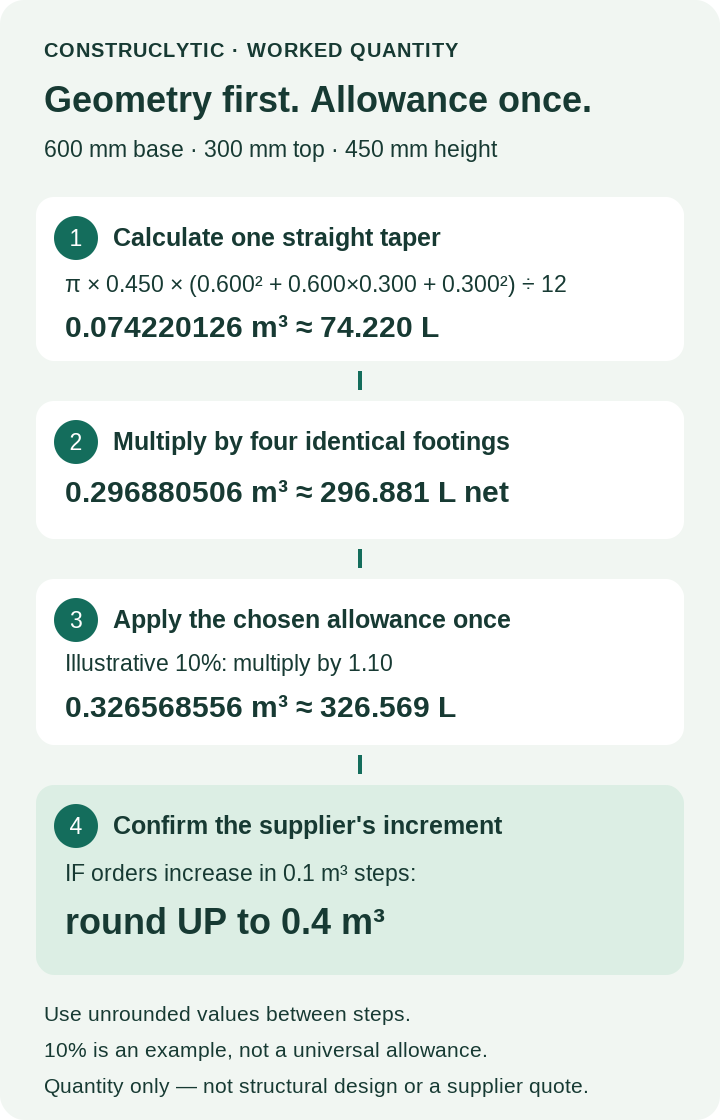
Convert all three measurements to metres: D = 0.600, d = 0.300 and h = 0.450. Then V = π × 0.450 × (0.600² + 0.600 × 0.300 + 0.300²) ÷ 12 = 0.074220126 m³. That is 74.220 litres of net concrete for one solid taper. These are illustrative dimensions, not a recommended footing size.
| Method | Volume | What it means |
|---|---|---|
| Two-diameter frustum | 74.220 L | Correct net geometry for this straight taper |
| 450 mm average-diameter cylinder | 71.569 L | Understates the net volume |
| Shortfall | 2.651 L · 3.57% | Percentage is relative to the exact frustum volume |
First check that the shape really is a frustum
This method covers a right circular conical frustum: two circular, parallel ends on the same centreline, joined by straight sides. Measure the inside of the form, or the intended concrete boundary. Measure height perpendicular to the end faces, not along the sloping side.
A curved bell, stepped base, square pad, irregular excavation or hollow form is not automatically this shape. Split a stepped footing into its actual non-overlapping pieces. Use the manufacturer's stated volume for a proprietary form when it describes the exact model and fill configuration. An excavation that is wider than the design consumes extra concrete; the design dimensions alone cannot measure that overbreak.
Why the formula includes both diameters
Wolfram MathWorld derives the frustum volume by integrating circular cross-sections through the height: V = πh(R² + Rr + r²) ÷ 3, using radii. Substituting R = D ÷ 2 and r = d ÷ 2 gives the diameter formula used here. Do not put diameters into the radius formula; that would multiply the result by four.
Use one length unit throughout. Metres produce cubic metres; inches produce cubic inches, which you divide by 1,728 for cubic feet or 46,656 for cubic yards. Millimetres produce cubic millimetres: divide by 1,000,000 for litres, or 1,000,000,000 for cubic metres. Converting the lengths first usually makes the arithmetic easier to check.
Primary mathematical derivation: Wolfram MathWorld, Conical Frustum
Why the average-diameter shortcut is short
For this example, the average diameter is (600 + 300) ÷ 2 = 450 mm. A 450 mm cylinder with the same 450 mm height holds 71.569 litres, not 74.220 litres. Averaging the diameter does not average the circular cross-sectional area through the taper.
Subtracting that cylinder formula from the exact formula gives an error of πh(D − d)² ÷ 48. The error is positive for unequal diameters and zero when they are equal. In this example it is 2.651 litres per footing, or 3.57% of the exact net volume. A waste allowance is not a substitute for getting the shape right.
Separate a straight neck from a tapered base
If the footing also has a straight cylindrical neck, calculate that neck separately: π × (neck diameter ÷ 2)² × neck height. Add it to the tapered section only when the heights describe separate, non-overlapping portions of concrete. Do not count the top of the taper a second time as part of the neck.
Construclytic's solid-tube calculator models a cylinder, not a taper. Use it for a genuinely straight neck or an equal-diameter check; it has no second-diameter input. The post-hole tool is a different calculation again because it can subtract an occupying round post. Neither tool certifies a footing design.
Use the solid-tube calculator for the cylindrical portion only
Turn net volume into an order without double-counting allowance
Four identical example tapers need 4 × 0.074220126 = 0.296880506 m³ net. If the project specifies an illustrative 10% allowance, multiply that total once by 1.10: 0.326568556 m³, or about 326.569 litres. Ten percent is an example input, not a universal recommendation.
Ask the supplier for the actual order increment and minimum charge. If the agreed increment is 0.1 m³, this example rounds up to 0.4 m³; a different increment can give a different order. For bags, divide the allowance-adjusted volume by the exact product's labelled yield in the same units, then round the total bag count up. Do not add a second allowance if the bag or order calculation already includes it.
Checks that catch a wrong entry
Swap the two end diameters: the calculated volume must stay the same. Set both diameters equal: the formula must become the ordinary cylinder formula. Set one end to zero: the mathematical limit is a cone, though a pointed cone is not a footing design recommendation.
We independently checked the worked arithmetic and the cylinder limit. In a synthetic live check on 19 October 2026, the solid-tube tool with a 300 mm diameter, 1,000 mm height, one tube and 0% allowance displayed 0.07 m³ net; the unrounded value is 0.070685835 m³. Switching the same geometry to imperial displayed 2.5 ft³ net. The tool's purchase totals use different metric and imperial increments, so those rounded orders are not unit-conversion equivalents. This check did not test a tapered-shape feature or any physical footing.
Measurement-to-order checklist
- Confirm a straight-sided circular taper; identify any separate neck, hollow space or irregular section.
- Record both inside diameters and perpendicular height, then convert all lengths to one unit.
- Calculate each non-overlapping shape and multiply by the number of identical footings.
- Apply the selected allowance once to the combined net quantity.
- Confirm supplier increments or exact bag yield, then round the final purchase quantity up.
Scope and limits
This guide estimates geometric concrete quantity only. It does not determine safe diameter, depth, reinforcement, concrete strength, soil bearing, frost protection or code compliance. Use the approved design and the actual form geometry. No external engineering certification, physical pour test or supplier price guarantee is claimed.
Common questions
Can I use the sloping side as height?
No. The formula needs perpendicular height between the parallel circular ends. A sloping measurement is longer and would overstate volume if entered as height.
Does this work for a curved bell footing?
Not exactly unless its concrete boundary is a straight-sided circular frustum. Use the exact form's published volume or break the actual geometry into suitable pieces; do not infer a curve from its top and bottom diameters alone.
Is the 0.074220 m³ example an order quantity?
No. It is the net geometric volume of one solid example taper. Counts, separate sections, a chosen allowance and the supplier's purchase increment still need to be considered.
Source checked on 19 October 2026
More concrete guides · Straight cylindrical section calculator