

One hole, measured dimensions
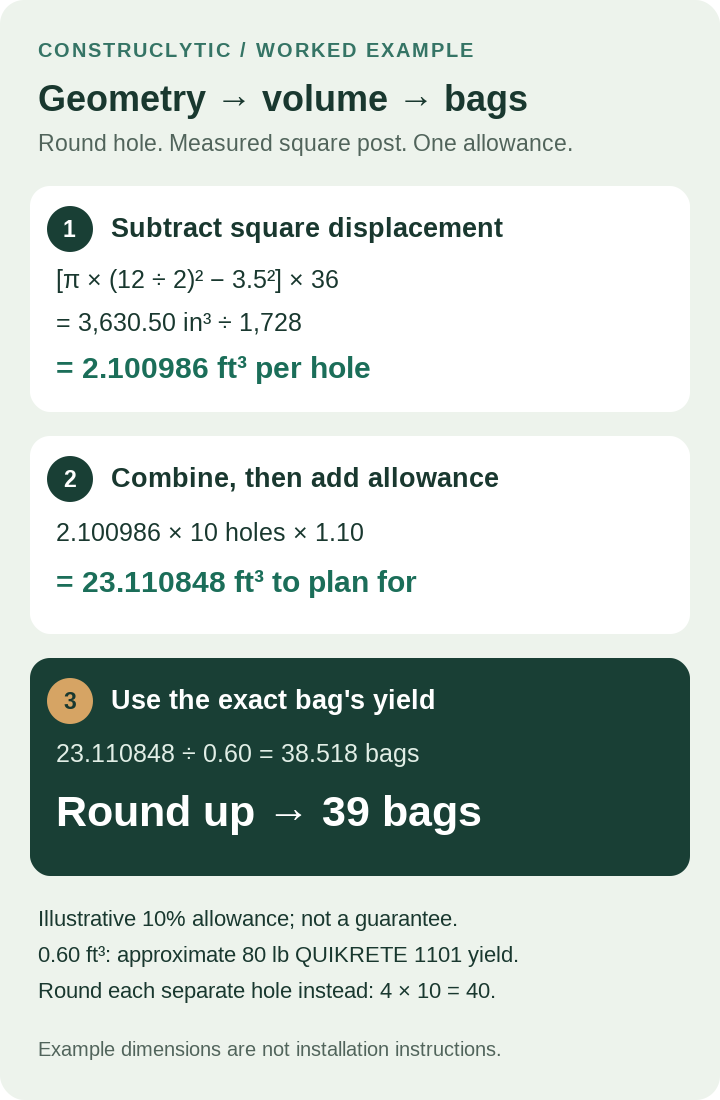
Hole diameter D = 12 in; square post width w = 3.5 in; concrete depth h = 36 in. The post occupies that entire concrete depth. V = [π × (12 ÷ 2)² − 3.5²] × 36 = 3,630.50 in³. Divide by 1,728 to get 2.100986 ft³, or about 0.077814 yd³. These are hypothetical dimensions for checking arithmetic, not a recommended footing design.
| Space occupied by post | Subtracted cross-section | Net concrete |
|---|---|---|
| Measured 3.5 × 3.5 in square | 12.250 in² | 2.101 ft³ |
| Measured 3.5 in diameter circle | 9.621 in² | 2.156 ft³ |
| No post in the concrete | 0 in² | 2.356 ft³ |
Use the post's actual shape and measurements
Measure the two sides of a rectangular post. Its area is width × thickness; for a square, this becomes width². The round hole's area is π × diameter² ÷ 4. A nominal product name is not a measurement, and a square's width is not a circular diameter.
For the example, the square occupies 12.25 square inches. A circle 3.5 inches across occupies only about 9.621 square inches. Subtracting that smaller circle leaves about 0.055 extra cubic feet per hole, a 2.61% difference from the square-post net quantity. Real irregular excavation can introduce a separate, larger uncertainty.
The square must also fit inside the circle: its corner-to-corner diagonal is √(width² + thickness²). Geometric fit alone does not establish enough concrete cover, an adequate footing size, frost depth or load capacity. Use the project requirements for those decisions.
Count concrete depth, not every inch excavated
If a project specifies a gravel layer or an unfilled space at the top, that volume is not concrete. For a hypothetical 42-inch excavation containing 6 inches of gravel and no top gap, the concrete depth would be 36 inches. The six inches here are an arithmetic assumption, not a universal installation recommendation.
Subtract the post only where it actually overlaps the concrete. If there is concrete below the end of the post, that lower part fills the whole hole area. Use V = hole area × concrete depth − post area × post overlap depth. Do not subtract the post through a base it does not occupy.
Product instructions differ. For example, the QUIKRETE 1101 data sheet describes a dry-concrete base for its post-setting method; it does not establish the hypothetical gravel arrangement above. Follow the specified mix and project details rather than combining instructions from different products.
QUIKRETE 1101 data sheet: exact product instructions and yield
Convert the net volume into a purchase quantity
Ten identical square-post holes from this example contain 21.009862 ft³. An illustrative 10% allowance gives 23.110848 ft³. Choose an allowance for your actual measurements, excavation and handling conditions; 10% is not a guarantee against running short.
The manufacturer gives an approximate yield of 0.60 ft³ for an 80 lb bag of QUIKRETE Concrete Mix No. 1101. At that stated yield, 23.110848 ÷ 0.60 = 38.518 bags, rounded up to 39 whole bags for the combined job. Use the yield on the exact product you will buy, not bag weight alone. This calculation does not select a suitable product or installation method.
Rounding each hole separately gives four bags per hole, or 40 bags for ten holes. The 39-bag combined estimate assumes the mixed material can be allocated across the job without losing the benefit of pooled quantities. If pours must be separate, record that purchase constraint. Keep calculations unrounded until the final purchase step.
How to use the current calculators honestly
Construclytic's post-hole calculator currently subtracts a circular post using a diameter. It does not offer a square-post input. Use it for a round post or enter zero for a solid cylindrical pour. Do not enter a square post's width as the diameter and label the answer exact for that square.
For a square post, calculate the net volume with the formula above, then use that volume and your chosen product yield to calculate bags. Keep any allowance separate so it is applied once. The comparison table shows why two tools can differ even when the same numbers appear in their fields.
We checked the public calculator on 18 October 2026 with a 12-inch hole, 3.5-inch round post, 36-inch concrete depth, one hole, 10% allowance and 0.60 ft³ per bag. It displayed 2.16 ft³ net and four bags. Switching units converted the dimensions to 304.8, 88.9 and 914.4 mm while keeping the bag-yield unit explicitly in ft³. This verifies the circular example, not a square-post calculation or a field pour.
Metric check and measurement limits
Use metres throughout to obtain cubic metres: [π × (0.3048 ÷ 2)² − 0.0889²] × 0.9144 = 0.0594933 m³ for the square-post example. If all dimensions are in inches, divide cubic inches by 1,728 for cubic feet or 46,656 for cubic yards. Do not mix millimetres, inches and feet in one expression.
This model assumes a straight cylindrical hole, a constant post cross-section and known concrete and overlap depths. Bell-shaped bases, stepped holes and over-excavation need separate measured volumes. A negative answer means the inputs or geometry are invalid; it is not zero concrete to buy. Check every hole instead of assuming the first one represents them all.
Measurement-to-order checklist
- Write down the round hole's measured diameter and the post's actual width and thickness.
- Record concrete depth and the depth over which the post occupies that concrete separately.
- Calculate hole volume minus post displacement, using one length unit throughout.
- Add independently measured irregular sections and combine the holes included in the pour.
- Apply one explicit allowance, divide by the exact mix yield and round the purchase up to whole bags.
Scope and limits
This guide checks quantities and unit conversions. It does not specify post spacing, hole dimensions, concrete cover, soil capacity, frost protection, structural design or a safe construction method. No physical installation or strength test was performed. Confirm the design and the exact product instructions before buying or placing concrete.
Common questions
Can I ignore the post and calculate a solid cylinder?
That gives a gross-hole quantity, not the net concrete around a post. In this example it is 2.356 ft³ instead of 2.101 ft³. If you deliberately order from gross volume, label that choice and avoid accidentally adding another displacement allowance.
Does a 4 × 4 product name prove the measured size?
No. Measure the actual cross-section of your post. The example assumes a measured 3.5 × 3.5 inches; it does not claim every product called 4 × 4 has those dimensions.
Is 39 bags the right order for every ten-post fence?
No. It follows only from the exact hypothetical dimensions, ten identical holes, one 10% allowance, a 0.60 ft³ yield and combined rounding. Change any input and recalculate.