
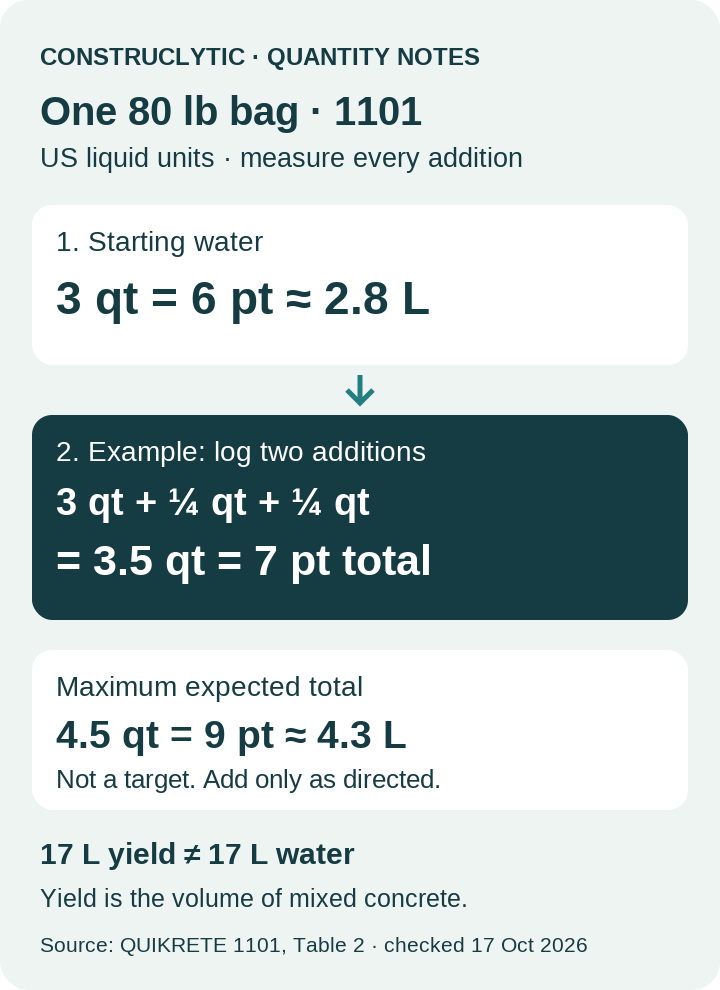
Worked water log: one 80 lb bag
Illustrative arithmetic, not a field test: start with 3 qt, then record two additions of ¼ qt each. Total water = 3 + 0.25 + 0.25 = 3.5 US qt = 7 US pt, approximately 3.31 L. The total is within the published 6–9 pt range, but that calculation alone does not prove correct consistency, strength or suitability. Do not add the remaining allowance just because it is available.
| Bag weight | Starting water | Maximum expected total |
|---|---|---|
| 40 lb | 3 US pt (1.4 L) | 4.5 US pt (2.1 L) |
| 50 lb | 3.5 US pt (1.7 L) | 5.5 US pt (2.6 L) |
| 60 lb | 4 US pt (1.9 L) | 7 US pt (3.3 L) |
| 80 lb | 6 US pt (2.8 L) | 9 US pt (4.3 L) |
| 90 lb; regional | 7 US pt (3.3 L) | 10 US pt (4.7 L) |
Read the product number before measuring water
This chart is for Concrete Mix No. 1101, a premixed blend of cement, sand and stone. It is not a recipe for pure cement, Fast-Setting Concrete, QUIKRETE 5000, Countertop Mix or a dry-pour method. Products from the same brand can have different instructions.
Match the product number and bag weight, then read the instructions on the bag you have. The linked manufacturer data sheet is revised October 2022 and was checked on 17 October 2026. Its 90 lb size is regionally available; the main product page lists 40, 50, 60 and 80 lb sizes. If your bag differs from this sheet, resolve the difference with QUIKRETE before mixing.
QUIKRETE's exact 1101 product page
Manufacturer data sheet: water table and mixing instructions
Starting water and maximum expected water are different
The table below transcribes the manufacturer's starting and maximum-expected amounts. The liter figures are the manufacturer's rounded equivalents. All pint and quart measures here are US liquid units; an Imperial pint is different.
For an 80 lb bag, 6 pints ÷ 2 = 3 quarts to start. The upper expected total, 9 pints ÷ 2 = 4.5 quarts, includes the starting water. It is not 4.5 additional quarts. Measure every addition and mix before deciding whether more is needed.
The sheet describes a stiff, moldable mixture without dry pockets or puddles. Do not automatically add an extra percentage for hot weather. Follow the exact product's temperature, placement and curing instructions rather than treating water as a general adjustment for every condition.
An 80 lb bag's 17-liter yield is not 17 liters of water
The manufacturer's approximate yield for an 80 lb bag is 0.60 cubic feet, or 17 liters, of mixed concrete. That is the resulting material volume, including cement and aggregate. It is separate from the water you add.
Estimate the concrete volume and whole-bag purchase count first. Then measure mixing water for each batch. A waste allowance for the quantity you buy is not a percentage to add to the water in every bag. You also cannot calculate a cement-only water ratio by treating the whole 80 lb bag as cement.
Calculate whole concrete bags from your pour volume
Keep a batch record you can check
Copy this line for each batch: Product and bag weight: ____ | Number of full bags: ____ | Starting water: ____ | Measured additions: ____ | Total water: ____ | Unit: ____ | Notes: ____.
Use one unit throughout the record. For example, 3 qt + ½ pt is 3.25 qt, not 3.5 qt. If you use liters, measure liters from the outset rather than repeatedly rounding conversions. For several bags, follow the mixer capacity and product instructions; arithmetic does not establish safe batch capacity.
Wear the protection specified by the manufacturer, including impervious gloves and eye protection, and avoid breathing dust or contacting wet mix. Do not test consistency with bare skin. Follow the safety data sheet and the product's placement and curing instructions.
Mixing-water checklist
- Confirm Concrete Mix No. 1101 and the exact bag weight; read your bag instructions.
- Select the matching starting amount and a measuring container marked in the correct units.
- Mix as directed. Add measured small amounts only as needed, mixing thoroughly each time.
- Record starting water plus every addition as the total; keep it distinct from mixed-concrete yield.
- Check the manufacturer's consistency, handling, placement and curing requirements before proceeding.
Scope and limits
This is a product-specific reading aid and an independently checked arithmetic example, not a mix design or structural specification. No on-site mixing or strength test was performed. Use the exact bag's current instructions and obtain project-specific advice where required.
Common questions
Is 3 quarts the final amount for every 80 lb bag?
It is the starting amount for this exact product. The manufacturer expects approximately 6–9 US pints in total for an 80 lb bag, adjusted as directed for consistency. Do not automatically use the maximum.
Can I use this chart for fast-setting concrete?
No. Match the exact product number and follow its own bag and data sheet. A similar bag color, brand or weight does not make the water instructions interchangeable.
Does being within the water range guarantee 4,000 psi?
No. This guide checks quantities and units; it does not test a batch. Mixing, placement, curing, site conditions and the specified application still matter.