
On this page
AnswerPatio pavers design calculatorOne formula, then the default facePattern, joint and a borderA 200 × 100 mm module is a different countBase and sand are not paversWorked example — 10 ft × 10 ft, 8 × 4 in face, 10% waste
Patio area is 10 × 10 = 100 ft², which is 100 × 0.09290304 = 9.290304 m². One face is (8 ÷ 12) × (4 ÷ 12) = 2/9 ft². Net pavers are 100 ÷ (2/9) = 450. With 10% waste, 450 × 1.10 = 495, already a whole paver, so the order is 495. A 12 × 12 ft patio is 144 ft² and 648 net pavers. 648 × 1.10 = 712.8, which rounds up once to 713 pavers.
| Patio | ft² | m² | Net pavers | Order at 10% |
|---|---|---|---|---|
| 8 × 8 ft | 64 | 5.94579456 | 288 | 317 |
| 10 × 10 ft | 100 | 9.290304 | 450 | 495 |
| 10 × 12 ft | 120 | 11.1483648 | 540 | 594 |
| 12 × 12 ft | 144 | 13.37803776 | 648 | 713 |
| 12 × 16 ft | 192 | 17.83738368 | 864 | 951 |
| 16 × 16 ft | 256 | 23.78317824 | 1152 | 1268 |
Landscaping calculator
Paver calculator
Patio area, individual paver face coverage, and whole-paver order quantity.
By Feroz Sheikh · Formula LAND-PAVER-001 v1.0.0 · Tested formula
LAND-PAVER-001v1.0.0Project inputs
Enter your measurements. Switching units converts the same project, including coverage and unit rates. Package yields keep the unit printed beside each field.
Calculated result
Pavers to order
LAND-PAVER-001Patio area ÷ paver face area × (1 + waste)
Patio area
One paver face
Base paver quantity
Planning estimate, not engineering advice. Confirm site measurements and product specifications. Calculation limits.
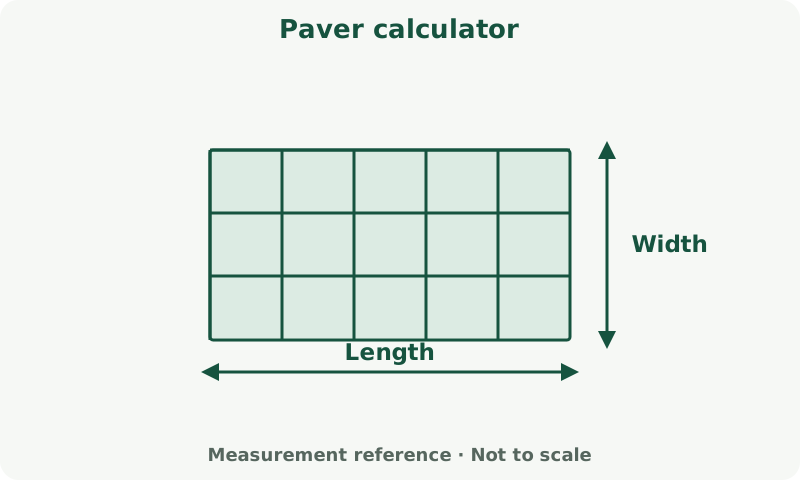
This calculator counts whole pavers from patio area and the face of one unit, plus a cut allowance. Formula LAND-PAVER-001 v1.0.0. Base and polymeric sand are companion tools. Add the count to an estimate. Pattern extras stay a field count.
- Measure the finished paved area and break complex geometry into rectangles where practical.
- Enter the face length and width of the selected paver rather than nominal package dimensions.
- Increase waste for diagonal, herringbone or other cut-heavy patterns and verify supplier packaging.
Size chart
Paver patio chart (8 × 4 in face, 10% waste)
Base and polymeric sand are companion tools. Pattern extras stay a field count.
| Patio | Primary | Check |
|---|---|---|
| 8 × 8 ft | 317 pavers | 64 ft² |
| 10 × 10 ft | 495 pavers | 100 ft² |
| 12 × 10 ft | 594 pavers | 120 ft² |
| 16 × 12 ft | 951 pavers | 192 ft² |
Metric example — 4 × 3 m patio. A 4 × 3 m patio of 8 × 4 in pavers with 10% waste returns 640 pavers.
- Paver face. Whole-paver count from patio area and one unit face. Base and joint sand stay companion tools. Omni — paver calculator methodology
Add your project costs
Enter supplier prices and any labour, equipment or delivery costs. Pick a currency — badges, inputs, and totals follow.
Costs use the bulk-yard, bag or truck-load rate you type. Construclytic does not fetch quarry or nursery prices. Delivery, fabric and edging stay separate lines. For GCC projects, select QAR, AED, SAR, KWD, OMR or BHD and enter local supplier rates.
Patio pavers design calculator
The patio pavers design calculator is the count on this page: patio area divided by one face, then one waste percentage, then one round-up. A 10 × 10 ft patio at the 8 × 4 in face and 10% waste is 495 pavers. A 12 × 12 ft patio is 713. Open the patio pavers design calculator with those inputs. The counting method, without this table, is how to count patio pavers.
One formula, then the default face
Pavers = ceil(patio area ÷ paver face × (1 + waste)). Formula LAND-PAVER-001. In the calculator the waste field is a percent: type 10 and the tool divides by 100 before it multiplies. It rounds up once, after that allowance, to a whole paver. These six rectangles divide evenly, so the net count is an integer. The tool’s base line is that net count.
The default face is 8 in by 4 in, the same default as the paver calculator and the same face as the 12 × 10 ft example on the counting guide. (8 ÷ 12) × (4 ÷ 12) = 2/9 ft² exactly. A square foot therefore holds 9 ÷ 2 = 4.5 pavers before waste. The calculator displays one face as 0.22 ft². Do not divide by 0.22. 100 ÷ 0.22 = 454.545…, which is not this count. 100 ÷ (2/9) = 450.
Pattern, joint and a border
The 10% column is the calculator’s default allowance for cuts, pattern, breakage and spares. It is not a herringbone percentage. Herringbone and 45° layouts need more cuts than a stack bond or a running bond. This site does not publish a second percentage. Mark the cuts, then raise the waste field. A soldier-course border is extra linear pavers. Keep it on its own line, as the counting guide already says.
The formula divides the patio by the face you enter. It does not add a joint on top of that face. If the supplier’s coverage module already includes the joint, enter that module and do not add the joint again. A nominal size is not the coverage when the product states a different module.
A 200 × 100 mm module is a different count
A 200 × 100 mm face is 0.02 m², which is 50 pieces per m² before waste. That module is not the 8 × 4 in column. The same 10 × 10 ft rectangle, entered as 3.048 m by 3.048 m with a 200 × 100 mm face and 10% waste, orders 511 pavers. The net count is 464.5152. A 12 × 12 ft rectangle at 3.6576 m by 3.6576 m, the same module and the same 10% waste, orders 736 pavers. The net count is 668.901888. Open the paver calculator in metric and type the module on the pallet. Do not scale 495 or 713.
Base and sand are not pavers
Base material, bedding sand, edge restraint and jointing material are excluded from LAND-PAVER-001. Compaction of the base is a gravel or paver-base line, not extra pavers. Measure that layer on the paver base calculator. Polymeric sand follows the coverage printed on the bag. Neither quantity is hiding inside 495 or 713.
The count is pieces for one rectangle. It is not a local price, a pallet price, or a laid rate. Ask the supplier for the current pack price, the pieces per pack and the delivery charge, and keep that quote dated. This page does not print one.
Do it in order
- Measure the finished rectangle. Keep feet with an inch face, or metres with a millimetre face.
- Enter one face. This table uses 8 in by 4 in. Replace it when the unit in your hand is different.
- Apply one waste percentage, then round up once to whole pavers. Keep base, sand and a border on other lines.
Planning boundary
This is a piece count for one rectangular face. It does not set a pattern, a joint width, a base thickness, drainage, edge restraint or a supplier price. Confirm the module on the pallet and the waste percentage with the layout.
Sources checked
Each link supports the point named in the text. A citation is not a product endorsement or a price for your site.
How many pavers for a 10x10 patio?
A 10 ft × 10 ft patio with an 8 × 4 in face and 10% waste needs 495 pavers. The net count is 450. A different face, or a waste percentage other than 10%, is a different order.
How many pavers for a 12x12 patio?
A 12 ft × 12 ft patio with the same 8 × 4 in face and 10% waste needs 713 pavers. The net count is 648, and 648 × 1.10 = 712.8, which rounds up once to 713.
How many 8×4 pavers are in a square foot?
One 8 × 4 in face is 2/9 ft², so a square foot holds 4.5 pavers before waste. The calculator displays that face as 0.22 ft². Divide by 2/9, not by 0.22.
Does 10% waste cover a herringbone pattern?
No percentage on this page is a herringbone allowance. The 10% is the calculator default for cuts, breakage and spares. Herringbone and 45° layouts need more cuts than a running bond. Mark the cuts and raise the waste field. A soldier-course border is a separate line.
Does the paver count include base and sand?
No. Base, bedding sand, polymeric sand and edge restraint are companion takeoffs. The piece count is the paver face only.